(cross posted from Chez VH)
I brought these ideas up at park day last week when a mom asked about when she could start working on Latin with her young children, which made me think some of you might like to hear about them too.
“The Slapping Game”
Get a set of English from the Roots Up Cards (there are two sets available). Or you can make your own (with help from a website listing Greek and Latin roots like this one). Root word is on the front (a color can be used to identify whether it’s Greek or Latin), English translation and possibly derivatives on the back. My kids (and their friends when we’ve done it as part of a class) love what has come to be known as “The Slapping Game”.
Lay out about six cards at a time with the root word facing up. You call out the English translation and the kids try to be the first one to slap the correct card (they should keep their hand on the card until you tell them which one is right – sometimes there are two correct answers if you have the Greek and Latin versions of the same word out at the same time). To make the game more smoothly I have a rule that they can’t talk during the game unless they raise their hand. If they do talk, they have to give up one of their cards. We’ve had a lot of fun with this game and found it very motivating for the kids to study the words at home on their own.
Root-Word Certamen
Certamen is kind of a team game show played by Latin scholars in Junior Classical League competitions and such. (You can read more about Certamen on the hand-dandy Wikipedia page.) The game consists of 15 or 20 questions on a wide variety of topics. These “toss-up” questions are worth 10 points each. If your team answers a toss-up question correctly, they also get a chance to answer two bonus questions, worth 5 points each.
We do a simplified version of this, also with the English from the Roots Up Cards. I hold up a card that everyone gets a chance to translate. The team with the correct translation gets 10 points. Then they are invited (for a possible 5 points each) to identify English derivatives of the word.

Showing posts with label Latin. Show all posts
Showing posts with label Latin. Show all posts
Thursday, October 14, 2010

Tuesday, April 06, 2010
Summer School and Discounts
 Homeschool Connections is offering online summer camps this school year and they're open for registration. There are classes for middle and high school with some fantastic teachers. If you register before the end of this month (April) you can get a $20 to $30 discount.
I always "school-light" over the summer. My school teacher friends tell me that they spend the first 2 to 3 months each school year just reviewing the lessons from the previous school year. I figure it's easier to do a little bit of school work over the summer than review come September.
Learning is a year-round experience and with online classes you can take your learning just about anywhere. We've had students take classes at the beach on their laptops, on vacation in Peru, and at the library in a visiting city.
Here are the Summer Camps being offered. Simply click on the camp titles to learn more or to register:
Job Search Skills Camp
Class dates: Monday through Thursday, May 24 to May 27
Total classes: 4
Starting time: 8 pm Eastern (7 pm Central)
Duration: 1 hour
Fee: $60 for entire 4-class camp. $20 Early Registration Discount before April 30, 2010
Instructor: Derek Prentice
Prerequisite: None
Suggested grade level: 10th grade to college level
Apologetics Camp
Class dates: Mondays through Thursdays, June 7 to 17, 2010
Total classes: 8
Starting time: 10:00 am Eastern (9:00 am Central)
Duration: 1 hour
Fee: $100 for entire 8-class course. $20 early registration discount before April 30, 2010
Instructor: Gary Michuta
Prerequisite: None
Suggested grade level: 9th to 12th
History Camp: Foundations of Christian Historiography
Class dates: Monday to Thursday, June 14 to June 17
Total classes: 4
Starting time: Noon Eastern (11:00 am Central)
Duration: 1 hour
Fee: $50 for entire 4-class course. $10 Early Registration Discount before April 30, 2010
Instructor: Phillip Campbell
Prerequisite: None
Suggested grade level: 9th to 12th
Latin I Camp: Introductory Level
Class dates: Mondays through Thursdays, June 21 to July 1, 2010
Total classes: 8
Starting time: 10:00 am Eastern (9:00 am Central)
Duration: 1 hour 15 minutes
Fee: $120 for entire 8-class course. $20 early registration discount before April 30, 2010
Instructor: Alecia Rolling and Kenneth Rolling
Prerequisite: None
Suggested grade level: 7th to 12th
Latin II Camp: Grammar Intensive
Class dates: Mondays through Thursdays, July 5 to July 22, 2010
Total classes: 12
Starting time: 10:00 am Eastern (9:00 am Central)
Duration: 1 hour 15 minutes
Fee: $180 for entire 12-class course. $30 early registration discount before April 30, 2010
Instructor: Alecia Rolling
Prerequisite: The student who wishes to enroll in this camp has at least learned the 1st through 3rd noun and adjective declensions as well as the 1st through 4th conjugations of the present tense. If the student has not learned this, he or she is encouraged to take Latin I Camp or enroll in Latin II camp with the understanding that it will be difficult and fast-paced.
Suggested grade level: 7th to 12th
Latin III Camp: Translation Intensive
Class dates: Mondays through Thursdays, July 26 to August 12, 2010
Total classes: 12
Starting time: 10:00 am Eastern (9:00 am Central)
Duration: 1 hour 15 minutes
Fee: $180 for entire 12-class course. $30 early registration discount before April 30, 2010
Instructor: Alecia Rolling
Prerequisite: The student who wishes to enroll in this camp has at least learned the 1st through 5th noun and adjective declensions as well as the 1st through 4th verb conjugations in all tenses (active and passive) or has successfully completed Latin Camp II.
Suggested grade level: 7th to 12th
Saturday, December 01, 2007
Review: Getting Started with Latin
 Getting Started with Latin: Beginning Latin for Homeschoolers and Self-Taught Students of Any Age by William E. Linney
Armfield Academic Press, June 2007, 224 pages
ISBN: 0979505100
www.gettingstartedwithlatin.com
To prepare for this review, I decided to put this book to practical use. Nightly, as our family sits down to family prayers, husband begins by doing a lesson orally with the kids. It's been a hit, a very nice family activity indeed. We all participate, from first to tenth grader, mom included. For some of us it's mostly review, for some it is all new, but we all look forward to it.
Getting Started with Latin is an introductory adventure into Latin. The path is easy with short lessons: only one new word or concept is introduced per lesson. Some lessons introduce a peculiarity of Latin or a grammar point. Sprinkled amidst the lessons there are interesting explanations of Latin expressions that we commonly encounter in English. For instance, between lessons 83 and 84 there is page entitled "Have you ever wondered what per capita means?"
The format is also suitable for being read aloud with a group of students or your whole family. We have enjoyed it as a family very much! And no, you do not need previous knowledge of Latin.
"A good general introduction!", says my husband. For the Catholic homeschooler this volume can serve well as a next level Latin for beginning students or for the next level for students who have done Our Roman Roots, albeit these will be able to go quite quickly through the first twenty lessons or so.
The book has a companion website with resources and downloadable pronunciation both on Classical and Ecclesiastical styles. Also, you can preview many sample pages.
Thursday, November 16, 2006
Review: Latin Proverbs: Wisdom from Ancient to Modern Times
 copyright 2002, Bolchazy-Carducci, 278 pages, softcover (6 inches x 6 inches)
This nifty, pocket-sized paperback is, quite simply, loaded with Latin proverbs (along with their English translations and whatever information is available about the source). There are over 1,100 proverbs in all and the appendices contain topical and author indices.
A few samples (note: the book does include macrons to indicate long vowel sounds, which are not easy to duplicate here):
Malum vas non frangitur.
The bad vase does not get broken.
(Anonymous)
Perenne conjugium animus, non corpus, facit.
Personality and not physical beauty makes a marriage lasting.
(Publilius Syrus, Sententia 481)
Homo sine religione sic ut equus sine freno.
Man without religion is like a horse without a bridle.
(Medieval)
Numquam aliud natura, aliud sapientia dicit.
Nature never says one thing and wisdom something else.
(Juvenal, Satires 14.321)
This makes a nice little supplement for a Latin class and could provide a lot of interesting discussion starters in any setting.
Reviewed by Alicia Van Hecke (11-16-06)
Available from Bolchazy-Carducci
Sunday, October 15, 2006
Monday, October 09, 2006
Review: Memoria Press' Henle Latin Guides
 Henle Latin I Guide for Units I-II
Henle Latin I Guide for Units III-V
Fr. Henle's Latin course is now well recognized as a superior choice among Catholic homeschoolers. Many curricula have adopted it and recommend it, and also publish syllabi and course plans of their own to aid families in breaking it down the lessons day by day. For instance, Mother of Divine Grace School and Kolbe Academy both have their own plans available beginning at the High School freshman level.
Memoria Press, publisher of Latina Christiana and other Latin texts, has introduced a syllabi with a different formula: a slower pace lesson plan/study guide for use after elementary Latin studies, beginning in 5th to 8th grade (but is not limited to students with previous Latin studies).
The lesson plans are well organized daily, and every page is a five day week. Each day lists the suggested activities and students can check the box by each of them. On the first pages the layout is simple and crisp, but as the course progresses and more text is necessary each day, it becomes a bit confusing, especially since the days are numbered outside of a margin. On this “side bar”, as I will call it, there are occasional extra daily lesson notes, helpful and simply put. Unfortunately once in a while these notes are a little longer and get trampled with the day numbering. Hopefully Memoria Press will fix these two problems simply, by removing the days' numbers from this side bar and placing them right by the beginning of each day’s activities where they belong.
Our children’s Latin tutor looked at this and was very pleased with this text's format—it is a plus to have the five days on a weekly page and a system of boxes that can be checked as the work is done. It looks like it would be very helpful especially for students tackling Latin on their own. Latin, as the author comments, has a way of “piling up quickly”. Memoria Press’s Guide to Henle Latin I may be a very helpful tool for homeschool Latin students. Included in the course plans are many resources such as a cumulative grammar tests and a section on how to make vocabulary and grammar cards.
You can access information on these products, and see sample pages at Memoria Press' website.
Reviewed by Ana Braga-Henebry (10-9-06)
Tuesday, July 25, 2006
A Wonderful Quote from On Christian Education
Pope Pius XI's encyclical On Christian Education (of 1929) spends a lot of time talking about the rights of Catholic schools with regard to the State (and thus doesn't apply point-by-point to homeschoolers throughout), but also makes some wonderful points about Catholic educational philosophy. Here's one of my favorite segments that covers a number of points applicable to Catholic homeschoolers today...
Read the entire text of the encyclical here
87. In such a school moreover, the study of the vernacular and of classical literature will do no damage to moral virtue. There the Christian teacher will imitate the bee, which takes the choicest part of the flower and leaves the rest, as St. Basil teaches in his discourse to youths on the study of the classics.[51] Nor will this necessary caution, suggested also by the pagan Quintilian,[52] in any way hinder the Christian teacher from gathering and turning to profit, whatever there is of real worth in the systems and methods of our modern times, mindful of the Apostle's advice: "Prove all things: hold fast that which is good."[53] Hence in accepting the new, he will not hastily abandon the old, which the experience of centuries has found expedient and profitable. This is particularly true in the teaching of Latin, which in our days is falling more and more into disuse, because of the unreasonable rejection of methods so successfully used by that sane humanism, whose highest development was reached in the schools of the Church. These noble traditions of the past require that the youth committed to Catholic schools be fully instructed in the letters and sciences in accordance with the exigencies of the times. They also demand that the doctrine imparted be deep and solid, especially in sound philosophy, avoiding the muddled superficiality of those "who perhaps would have found the necessary, had they not gone in search of the superfluous."[54] In this connection Christian teachers should keep in mind what Leo XIII says in a pithy sentence:In particular, I am encouraged to see his recommendations of the following: the study of Latin and classical literature, the concept of taking what is best from what we learn about education and setting aside the rest, and the importance of deep and solid teaching. Perhaps my favorite quote from this segment (worthy of Chesterton, it seems to me, but as it turns out, the Holy Father is quoting the Roman philosopher Seneca) is: "who perhaps would have found the necessary, had they not gone in search of the superfluous."
Greater stress must be laid on the employment of apt and solid methods of teaching, and, what is still more important, on bringing into full conformity with the Catholic faith, what is taught in literature, in the sciences, and above all in philosophy, on which depends in great part the right orientation of the other branches of knowledge.[55]
Read the entire text of the encyclical here
Friday, May 12, 2006
Latin Isn't Dead
Looking for some inspiration? The Way of the Fathers has an interesting post today on some modern Latin enthusiasts.
Thursday, March 16, 2006
History Antidote I: Give the Monks a Break!
The problem:
Some people who don't understand the concept of monastic life, religious life, cloisters, etc., assume that cloistered religious are selfish, unsociable people who are concerned only with saving their own souls. When they credit the monks for some degree of scholarship, it is often linked with blame for keeping books away from ordinary people. Here are some examples from one book (these are relatively mild examples, generally more frustrating in their implications and what the author fails to credit the monks for, than outright attacks on the Church)...
From The Story of Science: Aristotle Leads the Way by Joy Hakim (2004, Smithsonian Books, 282 pages, hardcover)...
In 529, the Christian Roman emperor Justinian closed the last of the traditional Greek schools. In Athens, the academy that Plato had founded almost 900 years earlier was shut down. Hardly anyone in the Christian world read the Greek philosophers anymore; they were labeled pagans (nonbelievers). Some of Plato's ideas did get incorporated in Augustine's philosophy, but the science of Aristotle and Ptolemy was now off-limits. These scientific ideas were thought to be dangerous...The Greek thinkers would soon be almost forgotten, except by a very few scholars - such as a learned Roman statesman named Boethius who translated Aristotle's writings on logic (but not science) into Latin and kept them from disappearing altogether. (pg. 201)
The first abbey founded by St. Benedict (Monte Cassino, in 529) started a European trend toward keeping knowledge behind closed doors. (pg. 201)
In Europe, for a few monks, there was a challenging life of the mind. Aristotle was responsible for that. His ideas on logic set rules for orderly discussions and arguments. Using Aristotle's logic, the monks learned to think analytically. They examined abstract ideas. That skill will be very useful in later centuries when science makes a comeback (pg. 203)
In the monasteries, clerics are focused on saving their souls through prayer, study, and isolation. When it comes to science, they quote Pythagoras, Plato, and Augustine. That trio all concentrated, on one way or another, on ideal forms in nature, which often kept them from considering the real world. (pg. 230)
The antidote:
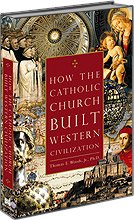 How the Catholic Church Built Western Civilization by Thomas E. Woods, Jr. (2005, Regnery Publishing, 280 pages, hardcover) has an amazing chapter called "How the Monks Saved Civilization." To backtrack just a little, though, I want to point out that Woods doesn't whitewash faults of the church or pretend that every Catholic was a saint. Here is how he put it...
"No serious Catholic would contend that churchmen were right in every decision they made. While Catholics believe that the Church will maintain the faith in its integrity until the end of time, that spiritual guarantee in now way implies that every action of the popes and the episcopate is beyond reproach. To the contrary, Catholics distinguish between the holiness of the Church as an institution guided by the Holy Spirit and the inevitable sinful nature of men, including the men who serve the Church." (pg. 2)
Modern man, particularly in the past few years, has become painfully aware of sinners in the Church, but has forgotten many wonderful contributions made by Catholics to civilization. This book seeks to remedy that through careful research, often citing non-Catholic sources who have documented these contributions.
Back to the monks...
The truth is that, even on a spiritual level, monks (on the whole) - and cloistered nuns for that matter - aren't just trying to save their own souls, but setting their lives aside for God to pray for others. The Poor Clare Monastery of the Sacred Heart of Mary, in Los Altos Hills, California (who we were priviledged to see a video about) live a life of work, prayer and poverty. They live away from the "real world", but one of the sisters has the job of keeping up with the news in order to have the sisters pray for problems in the world. I've had the privilege of meeting cloistered nuns on a few occasion through their "screen" (Carmelites in both instances) and was overwhelmed with the peace and beauty of their vocation. This isn't something "the world" will understand or appreciate.
But even on practical levels (ranging from preservation of ancient scholarship to the advent of a wide variety of practical technologies), as evidenced by Woods' book, the monks made amazing contributions throughout history - especially during the "Dark Ages." Here are a few samples (but you should get the book - it is well footnoted besides!)...
...there can be little doubt that the sixth and seventh centuries were marked by cultural and intellectual retrogression, in terms of education, literary output, and similar indicators. Was that the Church's fault? Historian Will Durant - an agnostic - defended the Church against this charge decades ago, placing blame for the decline not on the Church, which did everything it could to reverse it, but on the barbarian invasions of late antiquity. (pg. 9)
When the Mycenaean Greeks suffered a catastrophe in the twelfth century B.C. - an invasion by the Dorians, say some scholars - the result was three centuries of complete illiteracy known as the Greek Dark Ages. Writing simply disappeared amid the chaos and disorder. But the monks' commitment to reading, writing, and education ensured that the same terrible fate that had befallen the Mycenaean Greeks would not be visited upon Europeans after the fall of the Roman Empire. This time, thanks to the monks, literacy would survive political and social catastrophe. (pg. 44)
The oldest surviving copies of the most ancient Roman literature date back to the ninth century, when Carolingian scholars rescued them from oblivion..." (pg. 17)
... almost any classical text that survived until the eighth century has survived until today." (pg. 17)
Gerbert of Aurillac, who later became Pope Sylvester II (r. 999-1003) [said] "The just man lives by faith but it is good that he should combine science with his faith." Gerbert placed great emphasis on the cultivation of man's reasoning faculty, which God had not given him in vain. "The Divinity made a great gift to men in giving them faith while not denying them knowledge," Gerbert wrote. "[T]hose who do not possess it [knowledge] are called fools." (pg. 23)
In the eleventh century, the mother monastery of the Benedictine tradition, Monte Cassino, enjoyed a cultural revival, called "the most dramatic single event in the history of Latin scholarship in the eleventh century." In addition to its outpouring of artistic and intellectual endeavor, Monte Cassino renewed its interest in the texts of classical antiquity: "At one swoop a number of texts were recovered which might otherwise have been lost for ever; to this one monastery in this one period we owe the preservation of the later Annals and Histories of Tacitus ... the Golden Ass of Apuleius, the Dialogues of Seneca, Varro's De lingua latina, Frontinus' De aquis, and thirty-odd lines of Juvenal's sixth satire that are not to be found in any other manuscript." (pg. 42)
Although the extent of the practice varied over the centuries, monks were teachers. Saint John Chrysostom tells us that already in his day (c. 347-407) it was customary for people in Antioch to send their sons to be educated by the monks. (pg. 44)
Monks did more than simply preserve literacy. Even an unsympathetic scholar could write of monastic education: "They studied the songs of heathen poets and the writings of historians and philosophers. Monasteries and monastic schools blossomed forth, and each settlement became a center of religious life as well as of education." Another unsympathetic chronicler wrote of the monks, "They not only established the schools, and were the schoolmasters in them, but also laid the foundations for the universities They were the thinkers and philosphers of the day and shaped the political and religious thought. To them, both collectively and individually, was due the continuity of thought and civilization of the ancient world with the later Middle Ages and with the modern period." (pgs. 44-45)
Some people who don't understand the concept of monastic life, religious life, cloisters, etc., assume that cloistered religious are selfish, unsociable people who are concerned only with saving their own souls. When they credit the monks for some degree of scholarship, it is often linked with blame for keeping books away from ordinary people. Here are some examples from one book (these are relatively mild examples, generally more frustrating in their implications and what the author fails to credit the monks for, than outright attacks on the Church)...
From The Story of Science: Aristotle Leads the Way by Joy Hakim (2004, Smithsonian Books, 282 pages, hardcover)...
In 529, the Christian Roman emperor Justinian closed the last of the traditional Greek schools. In Athens, the academy that Plato had founded almost 900 years earlier was shut down. Hardly anyone in the Christian world read the Greek philosophers anymore; they were labeled pagans (nonbelievers). Some of Plato's ideas did get incorporated in Augustine's philosophy, but the science of Aristotle and Ptolemy was now off-limits. These scientific ideas were thought to be dangerous...The Greek thinkers would soon be almost forgotten, except by a very few scholars - such as a learned Roman statesman named Boethius who translated Aristotle's writings on logic (but not science) into Latin and kept them from disappearing altogether. (pg. 201)
The first abbey founded by St. Benedict (Monte Cassino, in 529) started a European trend toward keeping knowledge behind closed doors. (pg. 201)
In Europe, for a few monks, there was a challenging life of the mind. Aristotle was responsible for that. His ideas on logic set rules for orderly discussions and arguments. Using Aristotle's logic, the monks learned to think analytically. They examined abstract ideas. That skill will be very useful in later centuries when science makes a comeback (pg. 203)
In the monasteries, clerics are focused on saving their souls through prayer, study, and isolation. When it comes to science, they quote Pythagoras, Plato, and Augustine. That trio all concentrated, on one way or another, on ideal forms in nature, which often kept them from considering the real world. (pg. 230)
The antidote:
 How the Catholic Church Built Western Civilization by Thomas E. Woods, Jr. (2005, Regnery Publishing, 280 pages, hardcover) has an amazing chapter called "How the Monks Saved Civilization." To backtrack just a little, though, I want to point out that Woods doesn't whitewash faults of the church or pretend that every Catholic was a saint. Here is how he put it...
"No serious Catholic would contend that churchmen were right in every decision they made. While Catholics believe that the Church will maintain the faith in its integrity until the end of time, that spiritual guarantee in now way implies that every action of the popes and the episcopate is beyond reproach. To the contrary, Catholics distinguish between the holiness of the Church as an institution guided by the Holy Spirit and the inevitable sinful nature of men, including the men who serve the Church." (pg. 2)
Modern man, particularly in the past few years, has become painfully aware of sinners in the Church, but has forgotten many wonderful contributions made by Catholics to civilization. This book seeks to remedy that through careful research, often citing non-Catholic sources who have documented these contributions.
Back to the monks...
The truth is that, even on a spiritual level, monks (on the whole) - and cloistered nuns for that matter - aren't just trying to save their own souls, but setting their lives aside for God to pray for others. The Poor Clare Monastery of the Sacred Heart of Mary, in Los Altos Hills, California (who we were priviledged to see a video about) live a life of work, prayer and poverty. They live away from the "real world", but one of the sisters has the job of keeping up with the news in order to have the sisters pray for problems in the world. I've had the privilege of meeting cloistered nuns on a few occasion through their "screen" (Carmelites in both instances) and was overwhelmed with the peace and beauty of their vocation. This isn't something "the world" will understand or appreciate.
But even on practical levels (ranging from preservation of ancient scholarship to the advent of a wide variety of practical technologies), as evidenced by Woods' book, the monks made amazing contributions throughout history - especially during the "Dark Ages." Here are a few samples (but you should get the book - it is well footnoted besides!)...
...there can be little doubt that the sixth and seventh centuries were marked by cultural and intellectual retrogression, in terms of education, literary output, and similar indicators. Was that the Church's fault? Historian Will Durant - an agnostic - defended the Church against this charge decades ago, placing blame for the decline not on the Church, which did everything it could to reverse it, but on the barbarian invasions of late antiquity. (pg. 9)
When the Mycenaean Greeks suffered a catastrophe in the twelfth century B.C. - an invasion by the Dorians, say some scholars - the result was three centuries of complete illiteracy known as the Greek Dark Ages. Writing simply disappeared amid the chaos and disorder. But the monks' commitment to reading, writing, and education ensured that the same terrible fate that had befallen the Mycenaean Greeks would not be visited upon Europeans after the fall of the Roman Empire. This time, thanks to the monks, literacy would survive political and social catastrophe. (pg. 44)
The oldest surviving copies of the most ancient Roman literature date back to the ninth century, when Carolingian scholars rescued them from oblivion..." (pg. 17)
... almost any classical text that survived until the eighth century has survived until today." (pg. 17)
Gerbert of Aurillac, who later became Pope Sylvester II (r. 999-1003) [said] "The just man lives by faith but it is good that he should combine science with his faith." Gerbert placed great emphasis on the cultivation of man's reasoning faculty, which God had not given him in vain. "The Divinity made a great gift to men in giving them faith while not denying them knowledge," Gerbert wrote. "[T]hose who do not possess it [knowledge] are called fools." (pg. 23)
In the eleventh century, the mother monastery of the Benedictine tradition, Monte Cassino, enjoyed a cultural revival, called "the most dramatic single event in the history of Latin scholarship in the eleventh century." In addition to its outpouring of artistic and intellectual endeavor, Monte Cassino renewed its interest in the texts of classical antiquity: "At one swoop a number of texts were recovered which might otherwise have been lost for ever; to this one monastery in this one period we owe the preservation of the later Annals and Histories of Tacitus ... the Golden Ass of Apuleius, the Dialogues of Seneca, Varro's De lingua latina, Frontinus' De aquis, and thirty-odd lines of Juvenal's sixth satire that are not to be found in any other manuscript." (pg. 42)
Although the extent of the practice varied over the centuries, monks were teachers. Saint John Chrysostom tells us that already in his day (c. 347-407) it was customary for people in Antioch to send their sons to be educated by the monks. (pg. 44)
Monks did more than simply preserve literacy. Even an unsympathetic scholar could write of monastic education: "They studied the songs of heathen poets and the writings of historians and philosophers. Monasteries and monastic schools blossomed forth, and each settlement became a center of religious life as well as of education." Another unsympathetic chronicler wrote of the monks, "They not only established the schools, and were the schoolmasters in them, but also laid the foundations for the universities They were the thinkers and philosphers of the day and shaped the political and religious thought. To them, both collectively and individually, was due the continuity of thought and civilization of the ancient world with the later Middle Ages and with the modern period." (pgs. 44-45)
Monday, November 28, 2005
Review: How the Catholic Church Built Western Civilization
St. Athanasius Academy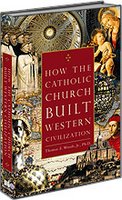
How the Catholic Church Built Western Civilization by Thomas Woods, Jr.
2005, Regnery Press, 256 pages, hardcover, Catholic
ISBN: 0895260387
Available from booksellers everywhere.
Thomas Woods, Jr. wrote a book to amend the erroneous attitude prevalent in society today – the Catholic Church has had only a negative impact on Western Civilization. Titled, How the Catholic Church Built Western Civilization, Dr. Woods, a history professor at a community college in New York, details the many contributions of the Catholic Church throughout history, primarily during the “Dark Ages” and “Middle Ages”.
From science to natural law, from the university system to the system of architecture, from the theories of free-market economies to the theories of morality, Dr. Woods details the influence and innovations of the Catholic Church.
This is not an unbiased, unemotional textbook. Dr. Woods states from the beginning that he is trying to show his students, and his readers, that the Church was in the forefront as the Western World began to civilize, began to make laws to protect the innocent, began to build and trade and participate in the world. Woods’ love of his Church and desire to set the record straight are prevalent throughout the text.
Using contemporary and modern scholars’ work, Dr. Woods defends his thesis admirably. Often quoting even those who are known anti-Church voices – including Martin Luther -- the history professor gives his reader lessons on the Benedictines’ actions which helped spread the Gospel and keep the “light of civilization” burning during the reign of Barbarianism known as the “Dark Ages”. He also gives a detailed account of the spread of monasticism and the many examples of the spread of practical, technical, charitable and educational skills accomplished by these monks.
Today’s university system is also beholden to the Church for the ability to debate, discover and develop new theories of life. He explains that the creation of the university system, directed by the Church, was committed to reason and rational argument and that there was a spirit of inquiry that has amounted to “a gift from the Latin Middle Ages to the Modern World”. Further, the Church is responsible for retaining much of the valuable scholarship from the ancient times: “massive translation efforts brought forth many of the great works of the ancient world….including the geometry of Euclid; the logic, metaphysics, natural philosophy and ethics of Aristotle; and the medical work of Galen.”
Woods explains that science is another field where the Church has been unfairly disparaged in recent times. Astronomy (even with the problems with Galileo), optics, biology, geology, seismology are just a few of the subjects where Catholic religious and laymen delved and developed theories and understandings.
Law – natural, international and modern – can also be tracked to the influence and innovation of the Catholic Church. Economics and the free-market theories are a direct contribution of Jesuit scholars – long before the eighteenth century theorists who get the bulk of the credit for free-market theories.
Dr. Woods’ book can become a bit didactic in his vehemence to set the record straight. The reader must understand that this book has a stated bias and must further understand that Dr. Woods is championing a cause that negates much of the history all of us have learned. That said, this is a book that all Catholics should read – a book that will help us all to explain to others the great contributions of our Church over the past two centuries. Interestingly, Southern Catholic College, a newly formed Catholic school in Georgia uses this book for their Freshman History text book.
Reviewed by: Mary C. Gildersleeve

How the Catholic Church Built Western Civilization by Thomas Woods, Jr.

2005, Regnery Press, 256 pages, hardcover, Catholic
ISBN: 0895260387
Available from booksellers everywhere.
Thomas Woods, Jr. wrote a book to amend the erroneous attitude prevalent in society today – the Catholic Church has had only a negative impact on Western Civilization. Titled, How the Catholic Church Built Western Civilization, Dr. Woods, a history professor at a community college in New York, details the many contributions of the Catholic Church throughout history, primarily during the “Dark Ages” and “Middle Ages”.
From science to natural law, from the university system to the system of architecture, from the theories of free-market economies to the theories of morality, Dr. Woods details the influence and innovations of the Catholic Church.
This is not an unbiased, unemotional textbook. Dr. Woods states from the beginning that he is trying to show his students, and his readers, that the Church was in the forefront as the Western World began to civilize, began to make laws to protect the innocent, began to build and trade and participate in the world. Woods’ love of his Church and desire to set the record straight are prevalent throughout the text.
Using contemporary and modern scholars’ work, Dr. Woods defends his thesis admirably. Often quoting even those who are known anti-Church voices – including Martin Luther -- the history professor gives his reader lessons on the Benedictines’ actions which helped spread the Gospel and keep the “light of civilization” burning during the reign of Barbarianism known as the “Dark Ages”. He also gives a detailed account of the spread of monasticism and the many examples of the spread of practical, technical, charitable and educational skills accomplished by these monks.
Today’s university system is also beholden to the Church for the ability to debate, discover and develop new theories of life. He explains that the creation of the university system, directed by the Church, was committed to reason and rational argument and that there was a spirit of inquiry that has amounted to “a gift from the Latin Middle Ages to the Modern World”. Further, the Church is responsible for retaining much of the valuable scholarship from the ancient times: “massive translation efforts brought forth many of the great works of the ancient world….including the geometry of Euclid; the logic, metaphysics, natural philosophy and ethics of Aristotle; and the medical work of Galen.”
Woods explains that science is another field where the Church has been unfairly disparaged in recent times. Astronomy (even with the problems with Galileo), optics, biology, geology, seismology are just a few of the subjects where Catholic religious and laymen delved and developed theories and understandings.
Law – natural, international and modern – can also be tracked to the influence and innovation of the Catholic Church. Economics and the free-market theories are a direct contribution of Jesuit scholars – long before the eighteenth century theorists who get the bulk of the credit for free-market theories.
Dr. Woods’ book can become a bit didactic in his vehemence to set the record straight. The reader must understand that this book has a stated bias and must further understand that Dr. Woods is championing a cause that negates much of the history all of us have learned. That said, this is a book that all Catholics should read – a book that will help us all to explain to others the great contributions of our Church over the past two centuries. Interestingly, Southern Catholic College, a newly formed Catholic school in Georgia uses this book for their Freshman History text book.
Reviewed by: Mary C. Gildersleeve
Thursday, September 29, 2005
Me and My Ducklings
Yesterday morning we decided to spend the afternoon at Old World Wisconsin. Things being what they are in busy homeschool families, it took several hours before everyone was done with their "essentials" (Math, Music, Latin and Religion - not necessarily in that order) and we finally left the house just after lunch. Halfway there, it started to rain (I did have an idea this might happen and a backup plan in mind before we left), so we decided to head to The Elegant Farmer - a country market we like to visit in the fall to get apple "seconds" for applesauce and pies.
The children loved this adventure of driving through the countryside listening to Lyrical Life Science while the baby slept. It doesn't hurt that our best stereo system by far is the one in the car.We've been so busy the last few years that we don't take these "adventures" nearly as much as we used to. Special field trips like this can be such great family time together.
There's not a lot to the farmer's market. The orchards are beautiful, but apple picking is only available on weekends (and we have some trees in the backyard to pick ourselves - more worm-eaten than these, though) and it was raining besides.
The place was delightfully uncrowded. Sometimes I think the beauty of these excursions is to spend some unhurried time together. They all rode on the huge wooden rocking horses and walked around and around on the hay bales before we entered the market. Their favorite part of this trip is the caramel apples. They picked out their apples (five different kinds to choose from) and were served by a nice lady who prepared them (on a stick or sliced) as they desired and even cut up a plain apple for my toddler. After I paid for these (she threw in the plain apple for free) and the children each had their paper bowl with their treat, the four older ones followed me and the double stroller around the store in a line from youngest to oldest. It was the funniest thing and far more duck-like than this was.
Funny how the simplest things can be so delightful. We were there for only a few hours, but it was something that all the children loved (ages 12 down to 1) and even the 12 year old enjoyed being one of the children for once. :)
We're not very consistent about saying the Rosary together as a family, but long car-rides are a good opportunity. On the way home, I started in, not sure if everyone in the back of the car (we have two middle seats out at present) would be able to hear. To my surprise the three oldest each begged to lead a decade and then my 12 year old offered to lead the final decade in Latin (they know the Our Father and Hail Mary in Latin, but I had to help out on the Glory Be which I was only able to remember once I started singing it).
Now this idea brought me back to an article I read in high school in my sister's copy of A Treasury of Catholic Digest: Favorite Stories of Fifty Years published by Ignatius Press. (I spent a lot of time during my homeschool years in my sister's apartment upstairs from Ignatius Press in San Francisco - this sort of thing, to me, was one of the real beauties of homeschooling in high school). A few years ago, I picked up this book myself from the Clearance section on the IP website. The article is entitled "Saying the Rosary in Tongues" by Robert Anderson (from the October 1982 issue of Catholic Digest).
The author had made the habit of praying a decade each in Latin, Spanish, Italian, French and German. This was a way for him to remember where he left off when he got interrupted in the middle of his prayers.
But I think - what an interesting idea for children! My children are already interested in different languages and different countries in the world. They might also consider offering those decades for those who speak that language. It might inspire some research into the missions, etc.
Here is the Latin for the Our Father, Hail Mary and Glory Be (might be best to continue the other prayers in English since we don't repeat them so often):
Pater noster, qui es in coelis, sanctificetur nomen tuum; adveniat regnum tuum; fiat voluntas tua, sicut in coelo et in terra; panem nostrum quotidianum da nobis nodie; et dimitte nobis debita nostra, sicut et nos dimittimus debitoribus nostris; et ne nos inducas in tentationem. Sed libera nos a malo. Amen.
Ave Maria, gratia plena; Dominus tecum; benedicta tu in mulieribus, et benedictus fructus ventris tui, Jesus. Sancta Maria, Mater Dei, ora pro nobis peccatoribus, nunc et in hora mortis nostrae. Amen.
Gloria Patri et Filio et Spiritui Sancto, sicut erat in principio, et nunc, et semper, et in saecula saeculorum. Amen.
Here are some links to prayers of the Rosary in other languages:
Rosary Prayers in Numerous Languages
The Our Father in over 1000 languages
The Hail Mary in over 150 languages
Subscribe to:
Posts (Atom)