Showing posts with label zlove2learn. Show all posts

Wednesday, January 02, 2008

Review: La Boda: A Mexican Wedding Celebration

La Boda: A Mexican Wedding Celebration, by Nancy Van Laan, illustrated by Andrea Arroyo.
May 1995, Little Brown & Co, Hardcover.
ISBN-10: 0316896268

Reviewed by Ana Braga-Henebry, M.A.

I love picture books, especially ones with warm, colorful, sweet illustrations. I love rhythmic, poetic language, made simple and accessible to children, and I love truly multicultural books!

This book brings all of these elements together, added to the universal theme of the sacrament of Matrimony. I couldn't help but love it at first sight--or at first reading.

How could one not love the bilingual first person dialog lines, as little Maria attends all of the many celebrations revolving around the wedding of her Alfonso and Luisa? The large families gathered, the music, dances, parades, fireworks, gifts--one, of course, a painting of Our Lady of Guadalupe--they all tell the story that culminate in the vows exchanged at church para siempre--for ever.

Alas, as in the case of many good books, this colorful, very Catholic book no longer in print, but try getting it from a used books source or your library!

Cross post: Ana's Journal

Monday, December 24, 2007

Review: A Pocket Guide to the Meaning of Life

A Pocket Guide to the Meaning of Life by Peter Kreeft
2007, Our Sunday Visitor, 64 pages, paperback.

Reviewed by Ana Braga-Henebry, M. A.

If any writer today can squeeze the meaning of life into a small 64 page booklet, the popular and prolific author Peter Kreeft can! The book is short, brief, almost laconic. One can throw it into the purse or even the pocket. And yet, the Pocket Guide to the Meaning of Life has it all: the truth of who we are, why we are here, where we are going, and how to get there.

The book is laid out in a simple Q&A format (see sample), displaying no more than 2 questions per page. Whenever he is able, Kreeft answers the questions with a single word or short phrase. Once in a while, a relevant, brief passage of the Bible is quoted. Sometimes, he answers the question posed by stating, "this is the way Jesus answered it", and proceeds then to quote from a Gospel writer. Saint Augustine is quoted a couple of times as well, and Saint John of the Cross and Gaudium et Spes once each.

This booklet will make a nice study aid for preparation for the sacrament o
f confirmation, but also beyond that-it would be helpful reading to just about anyone, in any stage of life!

Available at Adoremus Books

Saturday, December 22, 2007

Review: Aquinas 101

Aquinas 101, A Basic Introduction to the Thought of Saint Thomas Aquinas, by Francis Selman
Sept 2007, Ave Maria Press, 224 pages, Quality Paperback
ISBN: 0-87061-243-3

Reviewed by Ana Braga-Henebry, M. A.

If you, like me, had very little to no Thomistic Philosophy in high school or college, and would love to know more, this book is for you. What a pleasure for me it has been to read Aquinas 101 in preparation for this review. The book brings forth a surprisingly readable and sometimes funny Saint Thomas!

To begin, I quote from the publisher's site, Ave Maria Press:
A brief, engaging, and readable summary of the influential thought of St. Thomas Aquinas, one of the Catholic Church's greatest minds. In this clear, thoughtful and immensely readable book, Francis Selman offers summaries on some of the most complex topics in the writing of St. Thomas Aquinas. Selman deftly draws on the work of contemporary scholars while situating Aquinas in relation to the thinkers and schools of thought he was both confronting and drawing upon. The result provides an overview that places the thought of Aquinas both in his time and in our own.

The author succeeds indeed in both bringing the thought and philosophy of Saint Thomas Aquinas to students (or the interested reader) and in making it contemporary by referring to recent writings on St. Thomas.

The Prologue is a very nice biography of the saint's life, leaving the reader with admiration for him and interest for his thought. The language is light, down-to-earth, using quotidian anecdotes to shed clarity. Saint Thomas Aquinas comes through the book as a friendly, practical counselor. For instance, on page 114 we read:

For sorrow, St. Thomas Aquinas recommends four remedies: weeping, the company of friends, pleasure, and warm baths.

The paragraph that follows goes into the reasons St. Thomas believes these four remedies will help anyone in sorrow. So true, and so practical! Of course, the book also goes into more meaty philosophy, but it refrains from being too dense for the lay reader.

I also like the fact that Saint Thomas is referred to as Saint Thomas throughout the book.

In the Catholic homeschool, this book would make a very good choice for a High School introductory course on the philosophy of Saint Thomas.

Friday, December 07, 2007

Review: Pope John Paul II and Pope Benedict XVI: Keepers of the Faith

Pope John Paul II and Pope Benedict XVI: Keepers of the Faith (Great Life Stories) by Susan Provost Beller
2007, Franklin Watts, 111 pages, paperback
ISBN-10: 0531178471

Reviewed by Ana Braga-Henebry, M. A.

There is a whole lot be liked in this book, beginning with the title! The author has researched numerous interesting anecdotes about the lives of these two holy men so dear in the heart of many Catholics and non-Catholics alike, and the result is a fresh, easy to read and captivating double-biography.

An attractive format, crisp, clean layout, this will be a good resource for any homeschooler needing an overview of the life of our beloved John Paul the Great and a glimpse into the contemporary pope Benedict XVI as well. Susan Provost Beller does a fine job telling of their childhoods, the world they grew up in, their family sorrows and of their personal temperaments.

About every age page, there are side blurbs in blue background, about one third to one half of the page: they may feature explanations of an interesting curiosities such as Benedict XVI's love of cats or all about the Popemobile; or they may be of historical content, such as a table of papal nationalities.

The volume is generously illustrated and they complement very well the text. A timeline, a list of available resources and an index make it very user-friendly.

I was very pleased with the way the author of Pope John Paul II and Pope Benedict XVI: Keepers of the Faith treats delicate issues of religious faith in her book. I did find, however, a few problematic points, listed below. Taking these into consideration, I would recommend this book.

Red Flags (I found these to be the most important ones, watch for a few more minor ones):
  • Dominus Jesus is described as a document "which doesn't leave room for much compromising with other religions" (I am paraphrasing a bit). Compromising with other religions, of course, is not true Ecumenism.
  • A statement about how the Church needs to be "creative" in thinking about AIDS problems in Africa etc. (Like if the Church's changing teaching on contraception would eliminate AIDS. Indeed, that Church has been creative. Look at this article on the National Catholic Register to see that when abstinence is promoted AIDS cases sharply decline.
  • There is a picture of a consecration during a papal mass with a caption that says "here's the pope consecrating (or blessing) the wine". We know, as Catholics, that the moment of Consecration is light years beyond "blessing".

Available at your favorite bookseller or from Scholastic.

Monday, December 03, 2007

Review: A Student's Guide to Liberal Learning

A Student’s Guide to: Liberal Learning by, James V. Schall, S.J.
2000, ISI Books, 52 pages, paperback, Catholic

One thing people who homeschool worry a lot about is what college to send their children to. Many people homeschool to provide their children with the right kind of education—religious, liberal, etc. The last thing we want is for a bunch of flaky atheist, deconstructionist professors--or dorm life--to undermine our children’s assent and conformity to the natural and supernatural truths of our faith. So, do we send our children to one of those super-Catholic schools that are listed in the Cardinal Newman Society Guide? Or do we send them to one of the older, well established, but secularized to varying degrees Catholic universities and hope for a good campus ministry? Or a secular university, whether private or public? Is the Newman center okay? Will our children lose their faith? Their morals?

The answer, of course, varies with the child. All things being equal all Catholic schools should be genuinely Catholic and genuinely universities. If that were the case the decision would be a no-brainer, setting finances aside, because a genuinely Catholic university is the only real university there is. Alas, not all Catholic universities are Catholic. Not all fields are available at the Catholic schools that are. And many people can’t afford a private college or university of any sort. So, many people find it better to send their children to a state school or a Catholic school where the administration and faculty seem to have missed the memo (Ex Corde Ecclesia) about the meaning of Catholic identity.

The university, Catholic or not, has become a place where the focus is on the attainment of information that will lead to an increase of power, and the teaching of a sophistic rhetoric that will persuade others to allow you to exercise that power. Knowledge as such has become the only activity of the University, without any attention to the personal context of the cultivation of knowledge, or the practical significance of knowledge for living a good life—to the acquisition of wisdom. University students need wisdom as well as knowledge precisely at the age they are at and the university, where the student spends most of his time, needs to provide for the formation of the whole person, not just the intellect.

So, if you choose one of the schools that are not Catholic to the core can you count on losing your child to the secular humanists? Certainly not. Let us hope that our home education has given our children a good, solid foundation from which to negotiate the crazy things that are said and done out there, especially at the University.

Of course, our children can’t rest on their laurels. Neither can we. Because they will be growing exponentially as persons during their college years, they will need to continue their education as persons, not just professional training. First in importance, of course, is an active spiritual life and continued study of the faith. Also important, indeed essential, is a continued effort at a formation of the mind that corresponds to our genuine human nature and calling. And this does not merely mean studying the Catechism or encyclicals. It means learning to think like a Catholic about all things, such as politics, art, and science. It means gaining something that approximates a Catholic, liberal education.

Most universities, Catholic or otherwise, do not seem to know how to form the intellect according to the Catholic pattern, so our children will need guidance from somewhere else, especially if we ourselves did not get and have not since acquired such an education. Fortunately, that guidance is available in the person of James V. Schall, S.J., professor at Georgetown (a particularly secularized Catholic University).

In A Student’s Guide to: Liberal Learning, James V. Schall, S.J. gives some attention to the deficiencies of the contemporary university education and offers the discontent university student, or any adult serious about life, a three-pronged remedy.

Schall’s book can best be described as a 12-step program for higher education. First, we have to be aware of and acknowledge the problem in higher education and we have to admit we can’t do anything about it on our own. We are powerless before the relativistic forces of professional intellectuals. Then we have to know that a solution exists, help is available. Then we need to seek it.

The help that Schall proposes is threefold. “We need some self-discipline, our own personal library where we keep what we read, and real good guides” (p. 49). In order to remain intellectually sane in the poisonous atmosphere of many universities and the world around us, a person must take an antidote—which is a guided reading of the good books in the tradition of classical western liberal arts, whether ancient (Plato) or modern (Flannery O’Connor).

1. Self-discipline. The emphasis on reading makes the focus of the book on the intellectual life. Schall highlights, however, the role that moral disorder plays in losing sight the truth. “There is an intimate connection between our moral life and our intellectual life” (p 30). Although, as Newman held, the teaching of knowledge is the purpose of the university, that does not mean that the university is absolved from helping the student form his will so he can achieve his intellectual goals. Those for whom the formation of the intellect is the primary concern cannot neglect the moral virtues without sacrificing the intellectual ones as well. Although, Schall does not directly address the proper way to attend to the formation of the will, he does state that moral virtues are as important for the formation of the intellect as intellectual virtues. The focus is on the human mind which cannot function properly outside of a healthy will and body and affections. “If we do not have our lives in order under the rule of right reason, we will simply not see the first principles of reasoning and of living” (p. 11).

Intellectual virtues themselves are important as well: He, for instance, encourages, without naming them, the classical intellectual disciplines of the mind, the trivium of the liberal arts. The liberal arts aren’t just knowledge, but arts, distinct from the useful and fine, but arts nonetheless, directed at understanding and communicating the truth. That is why such books as Adler’s How to Read a Book, Sertillanges’ The Intellectual Life, and Schumacher’s A Guide to the Perplexed are as important as the great texts themselves, such as Augustine’s Confessions. Reading even great books without a mind trained in something like the trivium is less likely to gain true knowledge that can be communicated and put into action. We will be left with good, vague feelings about a text, but no clear understanding of how the ideas in the book relate to the whole.

2. Good books. One of the best features of this book is the lists. Not only do we find “Schall’s Unlikely List of Books to Keep Sane By” as Appendix I, but throughout the text there are short lists, serious ones, such as, “”Five Books on Thomas Aquinas,” “Five Classic Texts on Philosophy,” “Six Classic Texts never to be left unread,” “Seven Books About Universities,” and quirky and whimsical ones, such as “Three of the More than One-Hundred P.G. Wodehouse Novels” and “Four Books Once Found at a Used Book Sale.” Names of other good books not on any of the lists are sprinkled throughout the book. They are listed in the bibliography of the online version.

But, even good books aren’t all equally valuable. Being the good guide he is, Schall does not leave us without indication of what is the most essential reading. The two most important books are the Bible and Shakespeare. The seven intellectual heroes for Schall are: God (the Bible), Shakespeare, Plato, Aristotle, Cicero, Augustine and Aquinas. Honorable mention may be given to Eric Voegelin.

3. The need for guidance (authority). Schall is proposing initiation into a wisdom tradition, not just an intellectual ‘great conversation.” This implies a prior judgment of the value of given books: an authority. It is not enough, as in some Great Books programs, to be introduced into the Great Conversation about what is true or whether the truth is knowable. For young readers such an encounter can lead to confusion and cynicism. Great books don’t answer the question about what is true (p. 23), unless we already know how to tell. What is really needed is a prior judgment about those works that in fact articulate some aspect of the knowable and known truth and center our intellectual formation on them. This is done quite readily in particular disciplines, such as physics or economics. Why not in knowledge as such or knowledge as a whole? Schall has positioned himself as a master, a guide. He is pointing to the texts of intellectual sanity. This does not absolve our irreplaceable need to make our own judgment about the truth of the good books our guides suggest. Schall makes it clear that ideas need to be tested by the reader against their own experience (p. 41) and college students are at an age when they need to take responsibility to discern the truth of what they hear.

The goal of a liberal education as conceived by Schall is not just knowledge, but sanity—a mind that corresponds to the real so the person can act according to the truth and make decisions about the organization of his personal life and society that are in accord with the nature of the parts, the whole and their relationship. “Just because someone is smart does not mean he is wise” (p. 8.) The goal of the university is the cultivation of the intellect. But that intellect needs most of all to be able to address the meaning of the whole and our place in it and relation to it. Although we can “know” a truth, it isn’t actually true for us until we can and do act upon it. Our actions reveal what we believe (p. 21). Schall himself speaks on page one of “knowledge for its own sake.” He follows quickly, however, on page two with an assertion that we need not only “to know what is,” but also “to know what we ought to do” (p. 2).

The classic liberal tradition is precisely that, a wisdom tradition to be handed on. Because modern university culture has been deeply influenced by a philosophy of liberal education that believes that the critical faculty is the most important faculty of the human intellect, rather than the ability to receive and understand the accumulated wisdom of the ages, we have to cultivate the latter on our own.

Although this book is intended to be a guide for undergraduates, it may be equally useful for the many of us parents who may not have had access to a genuinely Catholic liberal education. And even those of us that did can benefit greatly from many of the books on Schall’s great lists. I personally have discovered in the past six months at least one life-changing book by reading Schall's Student's Guide.

A fuller version of the book can be found online here.

Saturday, December 01, 2007

Review: Getting Started with Latin

Getting Started with Latin: Beginning Latin for Homeschoolers and Self-Taught Students of Any Age by William E. Linney
Armfield Academic Press, June 2007, 224 pages
ISBN: 0979505100
www.gettingstartedwithlatin.com

To prepare for this review, I decided to put this book to practical use. Nightly, as our family sits down to family prayers, husband begins by doing a lesson orally with the kids. It's been a hit, a very nice family activity indeed. We all participate, from first to tenth grader, mom included. For some of us it's mostly review, for some it is all new, but we all look forward to it.

Getting Started with Latin is an introductory adventure into Latin. The path is easy with short lessons: only one new word or concept is introduced per lesson. Some lessons introduce a peculiarity of Latin or a grammar point. Sprinkled amidst the lessons there are interesting explanations of Latin expressions that we commonly encounter in English. For instance, between lessons 83 and 84 there is page entitled "Have you ever wondered what per capita means?"

The format is also suitable for being read aloud with a group of students or your whole family. We have enjoyed it as a family very much! And no, you do not need previous knowledge of Latin.

"A good general introduction!", says my husband. For the Catholic homeschooler this volume can serve well as a next level Latin for beginning students or for the next level for students who have done Our Roman Roots, albeit these will be able to go quite quickly through the first twenty lessons or so.

The book has a companion website with resources and downloadable pronunciation both on Classical and Ecclesiastical styles. Also, you can preview many sample pages.

Thursday, November 29, 2007

Review: The Story of Science: Newton at the Center

The Story of Science: Newton at the Center by Joy Hakim
2005, Smithsonian Books, 256 pages, hardcover

Also see Mary Daly's review of the first volume in this series.

Hakim's The Story of Science is an attractive but frustrating piece. Her comprehensive portrayal of the history of physics is extensively researched and beautifully illustrated, but marred by a steady stream of errors of science and history and an irritating political and philosophical drumbeat about things like population control and the proper separation (only now known to man) between religion and science.

The history of science is ambitious topic, requiring both an insight into science and a knowledge of history. It was perhaps wise to exclude almost completely the life sciences – biology, medicine, anthropology, and paleontology -- as well as the earth sciences of geology and meteorology. No controversy about Darwin here! Nevertheless, having made that decision, it might have been well to rename the book, indicating that it would be primarily "the story of physics", with substantial segments on chemistry and astronomy (which could hardly be left out of the history of physics) and no more than a passing mention of other topics.
It would be still clearer to say that Hakim is here presenting the stories of the physicists, in chronological order, with brief and mostly modern explanations of the insights they were working through. This is enough subject matter to be very challenging, very interesting, and certainly more useful than long explanations of old and erroneous ideas. We see the faces of the physicists, their equipment, and the geography of their homes and travels. Sidebars on the scientific or mathematical principles they were investigating are mostly well done but make it difficult to sort out what was actually known at a particular time, and are so numerous as to distract from the flow of her present-tense narrative.

Hakim's errors of science range from minor failures of clarity and information to real confusions indicating that she does not understand her material. The book cannot be used as a stand-alone science course; it must be checked.

- In a minor misstatement, she reports (p. 51) that Tycho Brahe "guesses that the stars are at least 700 times further than Saturn. He is wrong about that; the nearest star is more than 20,000 times farther…" Well, if his guess was "at least," he was right of course. What is important here is to note what a stretch was required of the 17th century imagination. The difficulty of accepting a sun-centered cosmos was not just traditionalism, but the radical expansion of our imagination regarding knowable space.

- More problematic is her boxed discussion of Tycho's supernova. First, (p 50 blue print in the green box) she says that "[I]n a split second, a massive star runs out of fuel… gravity collapses the core." Well, the collapse is sudden, and it happens after the star runs out of fuel, but the running out of fuel is not particularly abrupt, and it is the cooling after that depletion that brings about sudden collapse. And actually, Tycho's supernova worked a little differently, because it was not a core-collapse supernova. So it gets worse…

- (In the same box, black print,) Hakim says that "a supernova explosion destroys the original star. A nova explosion happens on the surface of a white dwarf…" On page 51, (still in the green box), she offers an image of "what's left of Tycho's 1572 supernova… There's no trace of a stellar core which suggests that the original star was a white dwarf in a binary system rather than a red giant. If a core does survive, it can become a neutron star or a black hole." So does a supernova destroy a star, or can it leave a core? And was this a nova – as suggested by the mention of its being a white dwarf -- or a supernova? An attentive student must run through several sources to find the answers. An ordinary reader may shrug – astronomy is too difficult for me!

- On page 85, there is a discussion of Galilean relativity. This is an unusual term, likely to confuse her readers as it certainly confused Hakim herself. She states that Galileo merely reported the visual difference between the appearance of a vertical path when a ball dropped from a mast and viewed by the moving ship's passengers -- and the curved appearance of the same ball's path as viewed from shore against a stationary background such as quiet clouds – my addition; there should be clouds in the picture – or something clearly stationary. Hakim says that "Albert Einstein, in the twentieth century, will help with the explaining." We don't need Einstein for this one; Newton works. A cloud will do it, and an artist who knows what he is illustrating. Einstein's topic was far more subtle.

- Hakim reports (p. 289) that "Hydrogen molecules (H2 with only two protons and electrons) are small and light. Most other molecules are heavier." Well, if molecules are composed of two or more atoms, all other molecules are heavier; this is her definition in two places. But, without commenting on the discrepancy, she alternates this with a definition which allows for single atoms -- such as those of the noble gases and the metals of coinage -- to be considered molecules. This is very confusing, and one wonders what she herself intended to convey.

- In discussing Avogadro's insight into gases, Hakim reports that: "His idea only makes sense if the particles in a gas are far apart, with space between them (which is the case – even for liquids and solids.)" No, no! This is only about gases. Adding the liquids and solids means Hakim didn't get the picture. Will her readers? (also p. 289)

- Hakim says, "An ellipse is not just any old oval; it has a precise curve." It would be best to say nothing about ovals, which are wider at one end, like an egg, but which do have a "precise" mathematical definition. (While the two foci of an ellipse are points, an oval has a circle at one focus.) Comparing the mathematical and astronomical term "ellipse" with the colloquial (not mathematical) term oval is too bad. (p. 358) Besides, she discussed the drawing of ellipses on pages 129-131. Since this is a history of sorts, it would have made sense to mention in this drawing lesson that the conic section was from Apollonius of Perga in 200 B.C. and the pin drawing was James Clerk Maxwell's idea in 1845.

- Hakim reports that metals "mostly have high melting and boiling points (except for mercury, which is the only metal that is liquid at room temperature) ." Yes, well, mercury has a very low melting point, but gallium melts in your hand, so that's a pretty low melting point too. (p. 296)

As I said, a range of errors of many types.

Her sense of history as a setting for the story of science is worse.

The first two paragraphs in the first chapter takes us right to the heart of the matter – the first one is about population growth leading to deforestation, starting in the Middle Ages. The next is a rather poorly considered piece on St. Joan of Arc, not a personality who needed to be included – rather carelessly -- in a history of science, merely to provide some color for the years before 1453, Hakim's starting date for this volume. As is often the case throughout this work, this loaded "setting" story is simply off-topic.

Continuing the topic of deforestation, we find, on pages 2-3, a full spread with images and text explaining how deforestation began in the Middle Ages, and continues with the destruction of the rainforest. "Big question: Will the forests continue to be threatened by population growth?"
This gratuitous tree politics with its eugenic bias raises all sorts of political and philosophical questions, not to mention that the very progress she lauds really depended on the plow because you can't do science until farming gets easy enough to leave time for other things. Anyway, a book in which the Big question is overpopulation is opposed to the Catholic attitude towards the miracle of human life. Big red flag right there on page 2, and it goes on.

Of course most of the history errors are the usual ones having to do with the stupid old middle ages, the foot-dragging Church, and the wonderful Greek and modern thinkers.

For example, Copernicus (p. 31) is about to make discoveries that "will challenge everyone's ideas about the heavens and the Earth," says Hakim, winding up to his sun-centered universe. But when we get there, we find (p. 38) that Aristarchus has been there. So now are we to suppose that Copernicus was the first guy to read Aristarchus since 200 B.C.? Nor is she correct in asserting that "the Aristotle/Ptolemy model has worked well enough for centuries." It was precisely because it didn't work well enough that Copernicus was asked to correct it. Of course it is only too well known that some people were irritated by the work of Copernicus, but by no means "everyone", for the Church which requested Copernicus' research set about using his work and had the new calendar in 40 years.

In philosophy, Hakim shows the colors of her consultants when she states (p. 19) that "The act of observing the [subatomic] particles changes their behavior." This is part of the thinking of many, but by no means all 20th century physicists, not of Einstein for example. Philosophically, it is called positivism; it is going out of favor, and it has arguably hobbled physics for half a century. In any case, it is not an established scientific fact, and it is opposed to Catholic philosophy, for it leads directly to the question whether anything can be known at all, as she puts it: "Is there really any certainty in science?"

Then, at the end of her book, Hakim raises the question why the western world has been the leader in scientific thought. Her answer, admittedly personal, is that we have the Greek heritage of freedom plus the Renaissance insight of tying mathematics to physics. Perhaps she does not even know that Father Stanley Jaki (20th century physicist and theologian with a specialization in the history of science) has argued for a very different answer – a conviction of order that only came with Christianity. This is not the place to argue with her, but only to say that she hasn't read the basic alternative arguments, (either Jaki or the more accessible Thomas Woods) on this topic and her answer is merely an uninformed and irritating opinion, oblivious of the Catholic contribution, and not seriously related to the actual history of science.

One last complaint would be hilarious if it were not meant seriously. On page 97, Hakim is talking about the end of our sun and wondering where we'll be when it goes: – "maybe in another solar system or another galaxy or another universe."

Hmmm. Another solar system is not such an easy matter.

Another galaxy? Clueless. As ignorant of the meaning of distance as Brahe was about the distance to the stars.

Another universe? Such words seemed to have a meaning when we thought other galaxies were other universes; now they are just noise. It's heaven or nothing, folks.

Reviewed by Mary Daly

Sunday, November 25, 2007

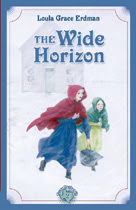
Review: The Wide Horizon


The Wide Horizon by Loula Grace Erdman, 2007, Bethlehem Books, 279 pages, Softcover.

The Pierce family has now lived in the Texas Panhandle for five years. Shy, insecure, fifteen-year-old Katie, who has always lived in the shadow of her confident, older, sister, Melinda, now steps to the forefront as she takes on new responsibilities when her sister marries and moves away to Amarillo and her mother, upset and worried about Grandmother’s broken hip, leaves to go back to east Texas to take care of her.

Taking over mama’s role of caring for the family is more than a new set of responsibilities for Katie as she puts on hold her dream of studying art and music. With her mother gone, Katie soon finds out just how much she knows about cooking in the kitchen. This is not the only area Katie will have to learn about. Always extremely sensitive, she now must deal with her older brothers’ teasing and the taunting of a bully at school. Oh, what to do and how to handle it!

This is a wonderful story to encourage a young girl to understand what it means to be virtuous and beautiful. Throughout the story, the author makes references to the inner beauty of a young lady’s heart, whether it is Katie’s or the other young women around her.

“Katie was aware of Mr. Palmer’s look of gratitude in Annie’s direction. She remembered her own deep sense of comfort at the sight of Annie when she had first arrived this afternoon. And, remembering all these things, Katie wondered if maybe Annie didn’t have a gift of her own—the gift of making people happy.

Perhaps that was the finest gift of them all.”

A woman’s beauty is not found in her wearing a bonnet to prevent her from turning brown, but much more.

While the opening chapter seems choppy and hard to follow, once the plot develops, the book is hard to put down. The plot comes to an exciting climax when a blizzard suddenly sweeps across the plains, burying Katie alone with the younger students in the one room school house. It is Katie’s resourcefulness that saves the day.

This is the second book in the Tales of the Texas Panhandle series.

Suggested reading level ages 11-Up.

Reviewed by Elizabeth Yank (11/25/2007).

Available from your favorite book store.

Review: Advent Reflections, Come, Lord Jesus!


Advent Reflections, Come, Lord Jesus! by Archbishop Timothy M. Dolan, 2007, Our Sunday Visitor, 64 pages, softcover, Catholic.

In Advent Reflections, Come, Lord Jesus! Archbishop Timothy M. Dolan shares four meditations, one for each week of Advent: “The Threes Comings of Jesus,” “St. John the Baptist,” St. Joseph: A Man Forgotten,” and “Our Blessed Mother Mary.”

With his earthy, conversational tone, Archbishop Dolan’s speaks to our hearts. As he talks about St. John the Baptist, he says, “You see, John’s entire ministry was captured in that one moment when he eyeballs Jesus coming out of the desert and bellows out to the crowd, pointing to Christ, ‘Behold, the Lamb of God, who takes away the sin of the world!’ (John 1:29). That was his job description—to point out Christ. With that, his job was done. He could have retired to Sun City.”

Archbishop Dolan combines teaching, inspiration, personal experience, and scripture in this lively text. To illustrate a point he is making, he weaves in short personal stories or adds scriptural passages that add depth and meaning.

Too often we listen to a sermon or read a spiritual book and later can’t recall what we have heard or read. To help us better remember his essential points, Archbishop Dolan uses catchy phrases. In describing “The Three Comings of Christ,” he says, “Our Lord comes to us in history, mystery, and majesty.”

Advent is a time of waiting and longing for the coming of our Lord. With all the bustle of Christmas preparations, it is easy to lose our focus on what this season is all about. Archbishop Dolan seeks to keep this message of hope alive with words of inspiration, questions for us to reflect on, and a prayer to carry us into the coming week.

Although there is only one meditation per week, instead of daily, there is plenty for us to reflect on during the week.

Not just “pretty” words, Advent Reflections, Come, Lord Jesus! challenges us to put our faith in action. This is an ideal resource for the whole family.

Reviewed by Elizabeth Yank (11/25/2007).

Available from your favorite Catholic book store.

Review: The Sacrament of Confirmation For Confirmation Candidates


The Sacrament of Confirmation For Confirmation Candidates by ESD (Edizioni Studio Domenicano) in collaboration with the Institute of St. Clement I, Pope and Martyr, 2006, New Hope Publications, 107 pages, Softcover, Catholic.

If you are looking for a concise, thorough, and orthodox (faithful to the teachings of the Church) resource for the sacrament of Confirmation, The Sacrament of Confirmation For Confirmation Candidates fits the bill.

The book is divided into three parts. The 1st section covers what the sacrament of Confirmation is and the rite and its effects, providing a basic understanding of the sacrament in question and answer form. The 2nd section breaks down the creed as it explains the truths of the Catholic faith. This also is presented in question and answer form. The 3rd section discusses the witnesses or martyrs of the faith as well as highlights the lives of a few, selected saints.

A sample question and answer from Part I is “When did Jesus institute the sacrament? After having promised this sacrament, Jesus instituted Confirmation on the day of Pentecost when He sent the Holy Spirit on the Apostles and Mary gathered in the Cenacle. The Apostles immediately began to preach and make known their faith in Jesus Christ, crucified and risen.”

Other questions in Part I include, “How is the sacrament of Confirmation conferred? What is chrism? What are the names of the seven gifts of the Holy Spirit? and many more.”

I particularly like the way they break down the creed into question and answer form in Part II, giving depth and meaning to the creed as they explain many truths of our faith. Many of these questions are not your typical questions and others are often posed to Catholics, making this a helpful appolgetics tool. “Is faith the only way to know that God exists? How can our reason prove the existence of God? Why do we say that God is Father? What does the expression ‘Mother of God’ mean in reference to the Virgin Mary?” and many more.

The spotlight on a few selected saints in Part III also serves as a starting point for candidates to pick their confirmation names, inspired by the holiness of the saints’ lives.

My one and only quibble with the text is the use of the expression “adult, mature Christians” when describing Confirmation. “Confirmation makes us perfect Christians, that is adult, mature Christians.” I think this terminology can lead to misunderstanding about this sacrament. The text does go on to explain that “Confirmation, therefore, by its very nature, ought to be celebrated before the Eucharist, that is, before First Communion. However, for serious pastoral reasons, in many countries it is celebrated later in order to assure adolescents a longer religious formation.”

I think the expression “adult, mature Christians” creates confusion because people think the child needs to choose this sacrament as a sign of adulthood, instead of spiritual maturity. Also, in the Eastern Rites the child does not even need to be the age of reason to receive Confirmation and is usually an infant.

Question #5 does address this issue. “Why do we say that Confirmation is the sacrament of adulthood? We do not say this because the sacrament must necessarily be received by adults, but because it enables us to bear witness to and defend the faith to others. This is proper to adulthood, though spiritual adulthood does not necessarily coincide with bodily age.”

The Catechism of the Catholic Church #1308 also clarifies this point. “Although Confirmation is sometimes called the ‘sacrament of Christian maturity,’ we must not confuse adult faith with the adult age of natural growth. . .” Because of space I urge you to read the rest of the quote.

Almost every page includes a colorful illustration, which brings to life the points of the text. One of the best examples of this is when the text discusses the seven gifts of the Holy Spirit. We see a galley ship with the seven gifts of the Holy Spirit written on the sails and seven virtues of the Holy Spirit written on the oars. Underneath the picture we read, “The virtues are like oars which propel the boat forward with great effort; the gifts of the Spirit are like sails which push the boat forward without any effort on the part of the rowers.” While the illustrations are not outstanding, they are quaint and colorful.

The logical presentation of the facts written in easy to understand language makes this book accessible for any age Confirmation candidate. More than rote questions for the candidate to memorize, the questions in this book provoke the candidate to reflect on the truths of the faith.

This book could be used in either a classroom or homeschool setting. When the time comes, I plan to use this with my children who are preparing for Confirmation.

Reviewed by Elizabeth Yank (11/25/2007)

Available from Hillside Education.

Saturday, November 24, 2007

Review: Saint Bakhita of Sudan, Forever Free


Saint Bakhita of Sudan, Forever Free by Susan Helen Wallace, FSP, 2006, Pauline Books & Media, 102 pages, Softcover, Catholic

Saint Bakhita is an outstanding example of gentleness, love, and faithfulness. In a world so easily consumed with bitterness, revenge, and self-centeredness, her virtues of forgiveness to others who deeply harmed her and gratitude for all of God’s goodness and grace in her life are inspiring. She often said, “’Be good, love the Lord, pray for the unhappy souls who do not know him yet. What a grace it is to know God!’”

At the young age of seven, Bakhita is traumatically torn from her village of Olgossa in the Darfur region of Sudan by slave traders. Although she and another young girl manage to escape, it is only temporary. Even though she receives “better” treatment as a house slave than other slaves, she is still subjected to cruel and inhumane punishments, nearly dying on more than one occasion because of being brutally whipped and viscously kicked and beaten.

That anyone should receive such harsh treatment by the hands of another human is beyond comprehension. These distressing scenes could be used as a point of discussion to explain the importance of spreading the Christian message of the incredible worth of a person’s soul, created in the image and likeness of God.

Remarkably, when Bakhita was asked later in life, “’What would you do if you met your kidnappers now?’ Without hesitating, she replied, ‘If I were to meet those slave traders who kidnapped me and even those who tortured me, I would get down on my knees and kiss their hands because if all that had not happened, I would be neither a Christian nor a religious now.’ Bakhita was a living witness to the power of forgiveness.”

Through a series of incredible events, Bakhita was brought to Italy, where she came into contact with the Daughters of Charity of Canossa, also known as the “Canossians.” After some time, she would join their order and become a beautiful example of God’s love to others.

Susan Helen Wallace, FSP, does a wonderful job of introducing us to this little known saint, whose faith journey begins with terror, fear, and unbelievable cruelty, but ends in the joy of the risen Lord.

St. Bakhita, pray for us.

Reviewed by Elizabeth Yank (11/24/07).

Available from your favorite Catholic bookstore.

Tuesday, November 20, 2007

Review: A Philadelphia Catholic in King James's Court

by Martin de Porres Kennedy
1999, Lilyfield Press, 316 pages, softcover, Catholic
ISBN: 0-9671492-1-5
Recommended for high school and adults
Reviewed by Suchi Myjak

Plot overview: After the tragic death of Mick O'Shea, a Catholic fireman from Philadelphia, his widow Tammy and their children are invited to spend the summer at the Kentucky farm of Tammy's brother Les and his family. The catch? Les is the fundamentalist pastor of a small homegrown "Bible-only" church. He believes it is his duty to "save" his sister and her family from the Catholic Church. The story centers on 17-year-old Michael, who is chosen as the preferred point of contact. At first, Michael is very uncertain about Scripture and feels that his uncle's explanations are right; however, Mick has given him a solid grounding in the Faith, so he seeks the answers in Mick's library.

The author does a fine job of portraying the characters with their struggles and motivations. For example:

  • Michael's search for truth is realistic, keeping us guessing how it will turn out.
  • Tammy allows her son to face the challenge, realizing that he is too old to just be told the answers. I love the way the author shows the impact of her prayerful support.
  • Fundamentalists are beautifully shown to be motivated by charity, while at the same time the weakness of their sola scriptura position is exposed.
  • I also enjoyed the contrast between the reactions of the characters who were seeking Truth and those who felt threatened by it. (As a convert, I can appreciate both positions!)

Not only is much excellent apologetic material included in a natural, enjoyable, and engaging format, but it is done with charity and even humility. Topics covered include the Inquisition, the papacy, the role of Mary, and the authority and interpretation of the Bible.

The richness of the Faith comes through in other ways as well. I especially loved the way the author portrays the uniqueness of the Sacrifice of Christ even as it is extended through time in the re-presentation of that Sacrifice in the Mass. Other elements woven into the story include questions of what is really important in life, the support of the Christian community, and the power of prayer.

All in all a very satisfying Catholic novel.

Highly recommended.

Wednesday, November 14, 2007

Review: Stations of the Cross for Children

Stations of the Cross for Children by Julianne M. Will
Our Sunday Visitor, 2005, 32 pages, paperback.

This small
booklet can make a nice resource for a child during Stations of the Cross devotions.

Each set of double pages depicts a full page illustration in a simplified iconic format and a page of text. Under the title of each station, in bold, is the traditional prayer of the Church: We adore you, o Christ and we praise you, because by your Holy Cross you have redeemed the world.

The language is directed towards children, and it has a personal and sincere tone. In a letter format, each opens with a Dear Jesus greeting and ends with an Amen. Subjects revolve around the everyday life of a child and the prayers are very nicely worded. See the sample page below.

This is a very nice resource, especially for Lent.

Reviewed by Ana Braga-Henebry, M.A.

Sample Page (click to enlarge):


Tuesday, November 06, 2007

Review: The Father Brown Reader

The Father Brown Reader: Stories from Chesterton, adapted by Nancy Carpentier Brown, illustrated by Ted Schluenderfritz
2007, Hillside Education, 141 pages, softcover

Nancy Carpentier Brown’s newest book, The Father Brown Reader: Stories from Chesterton, is an adaptation of four of G.K Chesterton’s Father Brown mysteries. It’s a delightful and captivating read-aloud, as well as a perfect book to hand to a young child to read on his own.

The four stories – The Blue Cross, The Strange Feet, The Flying Stars, and The Absence of Mr. Glass – are all easy reads, short enough to read in just one sitting. And be prepared to do so, because at the end of each chapter I always heard “just one more, please!” I bought the book intending to read it aloud to my 8-year old daughter and 10-year old son, but soon found that my 15-year old daughter always wanted to be within earshot as well.

Mrs. Brown has pared Chesterton’s already short stories down to the bone, and then broken them up into very short chapters of 2-3 pages each, in order to make them accessible to young readers.

However, she has in no way “dumbed them down”. She’s used Chesterton’s own words, including his unique phrasings. One such phrase was “elderly young woman”, which led to an interesting discussion of his use of those adjectives and what exactly Chesterton meant by them.

Mrs. Brown has also kept all the essential details so that even one who has never read the Father Brown mysteries previously can easily follow the clues and enjoy the fun of the surprise endings. She’s also included Chesterton’s subtle but powerful points of theology, including a discussion of the union of reason and faith.

These adaptations do not involve murder or any other truly unsavory situations, though petty theft, a mild chloroforming, and an apparent -- though not actual -- murder do figure into these innocent plots, adding just enough spice to keep the interest of readers (or listeners) of all ages.

There are a few helpful footnotes after each story. In some cases they are simply vocabulary definitions, in other cases pertinent comments on Chesterton’s fictional devices or historical elements of the story.

The black and white illustrations by Ted Schluenderfritz are delightfully charming. They add just the right touch to enhance, and never detract or distract from, the storyline.

This little book is a great way to get children started on lifelong enjoyment of the writing of G.K Chesterton.

Reviewed by Mary-Eileen Swart, 11/06/2007

Available from Hillside Education and Amazon

Monday, November 05, 2007

Hospitality with Graciousness


Tea and Cake with the Saints: A Catholic Young Lady’s Introduction to Hospitality and the Home Arts by Alice Cantrell
2007, Little Way Press, 108 pages, spiral bound softcover , Catholic

Catholic Heritage Curricula has done it again, delivering a beautiful resource that uplifts and instructs in their “gentle but thorough” tradition. This exquisitely designed and illustrated book is a perfect introduction to hospitality for girls aged 8-12 years old.

The book is divided by the seasons and includes tea party recipes and craft instructions for suggested feast days in each season. Tucked within those pages are lovely illustrations as well as instruction on little things that come up when you are puttering around the kitchen with your daughter, such as the difference between baking soda and baking powder, or the proper way to set the table. It includes special projects as well, such planting a Mary garden and making a gardening apron. Poetry and snippets from fine literature are placed graciously throughout the text.

Near the beginning is an explanation of how to make and keep a homemaking notebook. I am so delighted to see that. I remember thumbing through my Grandmother’s notebook and always wishing my mother kept one. What a great tradition for mother and daughter to work on together!

Even though I kept thinking of doing these things with my daughter as I read the book, it is really a book for the daughter. It is written and designed for her, from the handy smaller size of the book (7" X 10") to the larger-sized text font and the inviting illustrations. And the whole book—from its genteel ideas to its genteel presentation—is an invitation to graciousness that young girls will have a hard time resisting.

Sunday, November 04, 2007

Waugh's Helena Reprinted


Helena by Evelyn Waugh
1950, Loyola Press (Part of Loyola Classics Series), 230 pages, softcover, Catholic

I usually make it a point not to read an introduction to a book; I never want to be prejudiced by someone else’s take on a story. But since this would be the fourth time I would read Helena by Evelyn Waugh, I decided to read the introduction by George Weigel in Loyola Press’ reprint of this classic. And I am so glad I did.

I had always marveled that Waugh said he considered this to be the favorite of his novels when it was never as critically acclaimed as some of his others, and was, until this reprint, pretty much on the edge of obscurity. Weigel explores Waugh’s rationale, revealing some of what Waugh was thinking when he created the character of Helena.

What the reader must know is that this is not a work of accurate historical fiction, but a statement of Waugh’s idea of personal sanctity. Addressing the objection that Helena isn’t portrayed as a “saint,” Weigel reports that Waugh said:


I liked Helena’s sanctity because it is in contrast to all that moderns think of as sanctity. She wasn’t thrown to the lions, she wasn’t a contemplative, she didn’t look like an El Greco. She just discovered what it was God had chosen for her to do and did it. And she snubbed Aldous Huxley with his perennial fog, by going straight to the essential physical historical fact of the redemption.

I think appreciating this thought is the key to appreciating the whole novel, and what makes it a great Catholic story. It is historical fiction that is not meant to show the historical time period (though it does do that admirably), so much as to show one woman’s pilgrimage toward sanctity.

Waugh makes Helena the daughter King Coel (of “Ole King Cole” fame) and puts Constantius in Britain before he was historically there. She leaves her beloved home to marry Constantius and follow him into the political intrigues of the struggling empire. She is finally put aside so that Constantius may make a political marriage, and in those years of solitude she doesn’t simper and feel sorry for herself; she becomes a strong, successful woman who ultimately finds the Christian faith—a truth among the strange philosophies of the time. Once Constantine is Emperor and she is restored to the pages of history, she sets out to find the True Cross. No one knows how she finally found it, but Waugh has her meet in a dream the “Wandering Jew,” one who is doomed to walk the earth because he didn’t help Jesus on the road to Calvary.

One interesting thing is that Waugh does not portray Constantine in a good light at all. Although, Constantine did convert on his deathbed, Waugh has his character plan it that way; I suppose to make some sense of his not converting sooner. He seems a kind of contrasting archetype to the sincere seeking soul of Helena. Constantine says:


You start again, quite new, quite innocent, like a newborn child. But next minute you can fall into sin again and be dammed to all eternity. That’s good doctrine, isn’t it? Well, then what does the wise man do—the man in a position like mine where it’s impossible not to commit a few sins every now and then? He waits. He puts it off until the very last moment. He lets the sins pile up blacker and heavier. It doesn’t matter. They’ll be washed away in baptism, the whole lot of them and all he has to do is to stay innocent, just for a very short time, just to hold the devil at bay for a week or two, perhaps a few hours only.

Waugh’s writing is impeccably timed. The ache of Helena’s loneliness, even when she is with Constantius, is palpable. There is one place where Helena is trying to stop from laughing at something, and I found myself laughing out loud for her. Although this book is recommended on many high school reading lists, there is one scene in the first chapter that a parent might preread to determine its appropriateness for his/her children. At a banquet, Helena is daydreaming about being a horse, and it comes to a very sensual conclusion, in my opinion. It is important to the story, though, because as she comes out of her reverie, Constantius is staring at her and she knows that she belongs with him.

In addition to Weigel’s introduction, another great feature of this Loyola Press edition is a set of discussion questions provided at the back of the book. They are very thought provoking—not simple comprehension questions, but those that will provide opportunity for serious discussion.

Available from any bookstore.

Review: John Treegate's Musket

John Treegate's Musket by Leonard Wibberley
1959, Bethlehem Books, 188 pages, Softcover

The year is 1769, not even ten years after the French and Indian War, when colonial militia joined the British regulars in defeating the French. John Treegate proudly served in the militia then. As a symbol of his fierce loyalty to England and in remembrance of those days gone by, he proudly displays his musket over his mantle.

But the sentiments of Boston have drastically changed since then, now, with the imposition of heavy taxes from England, Boston is seething with resentment. Hoping to remedy the situation, John Treegate, a loyalist, sets off for England, but unable to meet with the proper officials, is detained longer than expected.

In the meantime, his eleven-year-old son, Peter, is apprenticed to Mr. Fielding, a manufacturer of barrel staves. Although Mr. Fielding is a man of principle, not all of his apprentices are. So begins Peter Treegate’s rough and tumble existence as he tries to navigate the turbulence that has set in Boston, leading to the Boston Massacre.

As the tension begins to mount, Peter’s life dramatically changes. After a series of terrifying events, Peter flees Boston, fearing for his life. His adventures take him far and wide as he sails rough seas aboard an illegal merchant ship, encountering hostile ships and fierce storms. When a hurricane strikes, he becomes shipwrecked, loses his memory, and is rescued by a fierce mountain man and more.

Reflecting the bitterness, anger, and strife of the times, Peter’s life is beset with violence, making this book more appropriate for ages 14 and up. No matter what happens to Peter, throughout the story, the principles of good and evil are clearly laid out. Peter chooses wisely and never succumbs to the revenge, hatred, or evil portrayed by others.

Reviewed by Elizabeth Yank (11/4/07).

Available from your favorite Catholic book store.

Saturday, October 27, 2007

Review: Blokus

Blokus
Board game for one to four players. Invented by Bernard Tavitian
2000, Sekkoia Company
www.blokus.com

Available from most toy retailers; discounted at http://www.timberdoodle.com

Blokus is more than just the most awarded game in recent history; it has almost become a phenomenon. A visit to the company website will quickly convince you how popular this game has become; international tournaments, online demonstrations, interactive Internet-based games, and even a free lost-part replacement service are just some of the features. After playing the game for several months, we are convinced that these awards are well-deserved!

Blokus is a strategy game in which a player attempts to place 21 differently- shaped pieces in one of four colors. The pieces are similar to those in a set of Pentominoes, ranging in size from 1 block to 5 blocks in varying regular shapes. The pieces can be rotated or flipped to help in placing them on the board. Pieces lock into the base grid, helping to preserve the developing game board as new pieces are laid. The winner is the player who has the fewest number of blocks left to place. A new player can learn to play literally in a minute or less. He can continue to play without mastering the game for weeks. Despite our experience with strategy games, and our desire to find "the" answer, we haven't yet found a consistent strategy that always wins. Numerous variations to the rules are available both in the box and on the Internet. It is possible to play solo, but we found it more enjoyable to play against another player.

In our homeschool, we place a high priority on critical thinking and logical analysis skills. I prefer to vary our curriculum from a book-oriented basis to a hands-on approach from term to term. Last term, I decided to focus on strategy games, and Blokus was our first-choice favorite! Even my 3-year-old became addicted to the game, despite the development of his own set of rules. Blokus is very appealing to a visual and/or spatially-oriented student, but is also exceptionally helpful in developing these skills in those of us not blessed with them naturally. In an educational setting, Blokus can also serve as a concrete example of rotations and transformations as well as an enjoyable addition to a geometry curriculum while remaining just plain fun.

Reviewed by Susan Kalis (10-26-07)

Saturday, October 13, 2007

Review: The Lark in the Morn


The Lark in the Morn by Elfrida Vipont, 1948, Bethlehem Books, 196 pages, Softcover.

Full of imagination and an adventurous spirit, 12-year-old Kit likes nothing more than to roam the fields playing pretending games with her best friends, Pony and Helen.

But life never stays the same. After an illness, Kit goes to live with her elderly Aunts and often visits her nearby cousins. In her cousins’ home, she is introduced to a totally new world of lively interests, music, and enduring friendships.

When she returns home, her life turns upside down. Cook, who had always been a dear friend, leaves for America to live with her brother, father seems more isolated and emotionally distant than ever, and Laura, her ever-busy cousin, who acts as her substitute mother, wants her troublesome charge out of the way.

Off to boarding school Kit is sent. Here Kit struggles to find the meaning of her life. Her brothers all seem so sure of what they want to do and who they are. Kit, on the other hand, wants to sing like her happy cousins. But Laura calls her singing “awful noise.” Will Kit rise up like the lark in the morning to find her voice, her true self, and the happiness she longs for?

The Lark in the Morn offers a peek into the life of a Quaker girl growing up in England during the mid-twentieth century. Her kindness to others in the face of petty nastiness at the boarding school is a wonderful example of Christian charity.

Suggested reading level ages 11-up.

Reviewed by Elizabeth Yank (10/13/2007).

Available from your favorite Catholic Bookseller.

Saturday, October 06, 2007

Review: The Church's Most Powerful Novenas

The Church's Most Powerful Novenas by Michael Dubruiel
Our Sunday Visitor, 2006, 288 pages
ISBN: 978-1-59276-097-8

Reviewed by Ana Braga-Henebry, M.A.

How often do we look for a novena? Chances are, if your family is like ours, you will love this little resource. It may be small, but it's packed full with novenas! More than 20 novenas, classified in categories such as Novenas to Christ and the Holy Spirit, to the Blessed Virgin Mary and to the Relatives of Jesus. Also to particular saints, American Saints, Holy Souls, and even a quick Novena by Blessed Teresa of Calcutta.

Introductory paragraphs and appendices offer historical vignettes, reasons to pray novenas, information on shrines related to the novenas, and more--including "novena problems to avoid"!

The small format volume is handsomely printed on "missal" pages and it will fit in anyone's handbag--mine is there! One never knows when a novena comes in need, does one?

One aspect of this user-friendly book that I specifically enjoyed is the historical information about each novena and the devotions surrounding each one. I discovered I have said novenas multiple times without fully knowing the very holy and interesting facts behind them!

Available at your favorite catholic bookseller.