Because the Pope is a witness of Christ and a minister of the Good News, he is a man of joy and a man of hope, a man of the fundamental affirmation of the value of existence, the value of creation and of hope in the future life. Naturally, this is neither a naive joy, nor a vain hope. The joy of victory over evil does not obfuscate - it actually intensifies - the realistic awareness of the existence of evil in the world and in every man. The Gospel teaches us to call good and evil by name, but it also teaches: "Do not be conquered by evil but conquer evil with good."
- Pope John Paul II, Crossing the Threshold of Hope

Showing posts with label Advent and Christmas. Show all posts
Showing posts with label Advent and Christmas. Show all posts
Monday, December 13, 2010
Advent Quote of the Day 16

Sunday, December 12, 2010
Advent Quote of the Day 15
What is Advent? Many answers can be given. We can grumble and say that it is nothing but a pretext for hectic activity and commercialism, prettified with sentimental cliches in which people stopped believing ages ago. In many cases this may be true, but it is not the whole picture.
We can say the reverse, that Advent is a time when, in the midst of an unbelieving world, something of the luminous quality of this lost faith is still perceptible, like a visual echo. Just as stars are visible long after they have become extinct, since their erstwhile light is still on its way to us, so this mystery frequently offers some warmth and hope even to those who are no longer able to believe in it.
We can also say that Advent is a time when a kindness that is otherwise almost entirely forgotten is mobilized; namely, the willingness to think of others and give them a token of kindness. Finally we can say that Advent is a time when old customs live again, for instance, in the singing of carols which takes place all over the country. In the melodies and the words of these carols, something of the simplicity, imagination and glad strength of the faith of our forefathers makes itself heard in our age, bringing consolation and encouraging us perhaps to have another go at that faith which could make people so glad in such hard times.
This latter kind of experience of Advent brings us quite close to what the Christian tradition has in mind with this season. It has expressed its view of Advent in the bible texts which it took as the season's signposts. I will mention just one of them, a few verses from Paul's letter to the Christians in Rome. There he says, '...it is full time now for you to wake from sleep... the night is far gone, the day is at hand. Let us then cast off the works of darkness and put on the armor of light, let us conduct ourselves becomingly as in the day, not in revelling and drunkenness, not in debauchery and licentiousness, not in quarrelling and jealousy. But put on the Lord Jesus Christ...' So Advent means getting up, being awake, emerging out of sleep and darkness.
- Cardinal Ratzinger, Seek That Which is Above
Saturday, December 11, 2010
Advent Quote of the Day 14
To have Christian hope means to know about evil and yet to go to meet the future with confidence. The core of faith rests upon accepting being loved by God, and therefore to believe is to say Yes, not only to him, but to creation, to creatures, above all, to men, to try to see the image of God in each person and thereby to become a lover. That’s not easy, but the basic Yes, the conviction that God has created men, that he stands behind them, that they aren’t simply negative, gives love a reference point that enables it to ground hope on the basis of faith. - Cardinal Ratzinger, Salt of the Earth
Friday, December 10, 2010
Advent Quote of the Day 13
Love tends to become like the one loved; in fact, it even wishes to become one with the one loved. God loved unworthy man. He willed to become one with him, and that was the Incarnation.
- Archbishop Fulton Sheen, The Quotable Fulton Sheen
Thursday, December 09, 2010
Advent Quote of the Day 12
All this indescribable thing that we call the Christmas atmosphere only hangs in the air as something like a lingering fragrance or fading vapour from the exultant explosion of that one hour in the Judean hills nearly two thousand years ago. But the savour is still unmistakable, and it is something too subtle or too solitary to be covered by our use of the word peace. By the very nature of the story the rejoicings in the cavern were rejoicings in a fortress or an outlaw's den; properly understood it is not unduly flippant to say they were rejoicings in a dug-out. It is not only true that such a subterranean chamber was a hiding-place from enemies; and that the enemies were already scouring the stony plain that lay above it like a sky. It is not only that the very horse-hoofs of Herod might in that sense have passed like thunder over the sunken head of Christ. It is also that there is in that image a true idea of an outpost, of a piercing through the rock and an entrance into an enemy territory. There is in this buried divinity an idea of undermining the world; of shaking the towers and palaces from below; even as Herod the great king felt that earthquake under him and swayed with his swaying palace.
- G.K. Chesterton, The Everlasting Man
Wednesday, December 08, 2010
Advent Quote of the Day 11
Do we know Jesus? Only if we recognize in him the presence and the logic of absolute divine love. This love can refine whatever in us does not oppose the flame of love, but whatever refuses to bring forth love's fruit will be let wither, dug up and burned.
Jesus interprets God in the language of a human life. For God, the humanity of Jesus is not an inert, mechanical alphabet simply used to put the absolute into words. The interpreter himself speaks with his whole existence of flesh and blood. The picture, the parable which the man Jesus is, does not face, since the eternal prototype radiates in him, is perfected in him. It can do this because, in God, the eternal Son always was the eternal Father's self-offering and self-interpretation. To understand Jesus' word, which coincides with his existence, is to have access (and there is no other!) to the eternal trinitarian mystery of love. This is only possible in the Holy Spirit.
-Hans Urs von Balthasar, Does Jesus Know Us? Do We Know Him?
Advent Quote of the Day 10
And as Jesus prepares for the messianic entry into the city which will kill him as it has killed all the prophets, he bursts into tears - surely the most moving scene in the Gospel, eternal love being forced to weep over the strength of human rejection: "Would that even today you knew the things that make for peace! But now they are hidden from your eyes."
- Hans Urs von Balthasar, Does Jesus Know Us? Do We Know Him?
Monday, December 06, 2010
Advent Quote of the Day 9
For those without faith in a loving God it is impossible to realize that suffering can be understood as a gift of God, and it would be impossible to experience that inner joy and peace that absolute trust in God’s providential love alone can bring us, no matter in what situation we find ourselves. It is only with faith in Jesus as the Son of God, who has shared our suffering that we are able to find meaning in suffering. I have often reflected on what the famous dramatist and diplomat of France, Paul Claudel, said with such wisdom and faith: “Jesus did not come to explain away suffering or remove it. He came to fill it with His presence.” Often it is only long after the suffering has passed, that we begin to understand more fully God’s loving hand in our lives even at that time.
- Bishop John Steinbock of Fresno, who died of cancer yesterday
Advent Quote of the Day 8
We can try to limit suffering, to fight against it, but we cannot eliminate it. It is when we attempt to avoid suffering by withdrawing from anything that might involve hurt, when we try to spare ourselves the effort and pain of pursuing truth, love, and goodness, that we drift into a life of emptiness, in which there may be almost no pain, but the dark sensation of meaninglessness and abandonment is all the greater. It is not by sidestepping or fleeing from suffering that we are healed, but rather by our capacity for accepting it, maturing through it and finding meaning through union with Christ, who suffered with infinite love.
- Pope Benedict XVI, Spe Salvi
Saturday, December 04, 2010
Advent Quote of the Day 7
A mass of legend and literature, which increases and will never end, has repeated and rung the changes on that single paradox; that the hands that had made the sun and stars were too small to reach the huge heads of the cattle. Upon this paradox, we might almost say upon this jest, all the literature of our faith is founded...
I mean that all the eyes of wonder and worship which had been turned outwards to the largest thing were now turned inward to the smallest...
It is true that the spiritual spiral henceforward works inwards instead of outwards, and in that sense is centripical and not centrifugal. The faith becomes, in more ways than one, a religion of little things.
- G.K. Chesterton, The Everlasting Man
Friday, December 03, 2010
Advent Quote of the Day 6
This text from the Letter to the Philippians introduces us into the mystery of Christ's kenosis. To express this mystery the apostle uses first of all the words "emptied himself," which refers especially to the reality of the Incarnation. "The Word became flesh" (Jn 1:14). God the Son assumed human nature, humanity, and became true man, while remaining God! The truth about Christ as man must always be considered in relation to God the Son. This permanent reference itself is indicated by St. Paul's text. "He emptied himself" does not in any way mean that he ceased to be God; that would be absurd! It means rather, as the apostle perceptively expressed it, that "he did not deem equality with God something to be grasped," but "though he was in the form of God" (in forma Dei), as the true Son of God, he assumed a human nature deprived of glory, subject to suffering and death, in which he could live in obedience to the Father, even to the ultimate sacrifice.
Pope John Paul II, "Jesus Christ Emptied Himself", General Audience, Feb 17, 1988
Thursday, December 02, 2010
Advent Quote of the Day 5
The Christian faith brings us exactly that consolation, that God is so great that he can become small. And that is actually for me the unexpected and previously inconceivable greatness of God, that he is able to bow down so low. That he himself really enters into a man, no longer merely disguises himself in him so that he can later put him aside and put on another garment, but that he becomes this man. It is just in this that we actually see the truly infinite nature of God, for this is more powerful, more inconceivable than anything else, and at the same time more saving.
- Joseph Cardinal Ratzinger, God and the World: A Conversation with Peter Seewald
Wednesday, December 01, 2010
Advent Quote of the Day 4
Many women, if they were expecting a child, would refuse to hurry over the hills on a visit of pure kindness. They would say they had a duty to themselves and to their unborn child which came before anything or anyone else.
The Mother of God considered no such thing. Elizabeth was going to have a child, too, and although Mary's own child was God, she could not forget Elizabeth's need - almost incredible to us, but characteristic of her.
She greeted her cousin Elizabeth, and at the sound of her voice, John quickened in his mother's womb and leapt for joy.
"I am come," said Christ, "that they may have life, and may have it more abundantly." Even before He was born His presence gave life.
With what piercing shoots of joy does this story of Christ unfold! First, the conception of a child in a child's heart, and then this first salutation, an infant leaping for joy in his mother's womb, knowing the hidden Christ and leaping into life.
How did Elizabeth herself know what had happened to Our Lady? What made her realise that this little cousin who was so familiar to her was the mother of her God?
She knew it by the child within herself, by the quickening into life which was a leap of joy.
If we practice this contemplation taught and shown to us by Our Lady, we will find that our experience is like hers.
If Christ is growing in us, if we are at peace, recollected, because we know that however insignificant our life seems to be, from it He is forming Himself; if we go with eager wills, "in haste," to wherever our circumstances compel us, because we believe that He desires to be in that place, we shall find that we are driven more and more to act on the impulse of His love.
-Caryll Houselander, The Reed of God
Tuesday, November 30, 2010
Advent Quote of the Day 3
It is commonly in a somewhat cynical sense that men have said, "Blessed is he that expecteth nothing, for he shall not be disappointed." It was in a wholly happy and enthusiastic sense that Saint Francis said, "Blessed is he that expecteth nothing, for he shall enjoy everything." It was by this deliberate idea of starting from zero, from the dark nothingness of his own deserts, that he did come to enjoy them.
- G.K. Chesterton, St. Francis of Assisi as quoted in Advent and Christmas Wisdom from G.K. Chesterton
Reminder: Today is the first day of the St. Andrew/Christmas Novena. It is said 15 times each day from today (the feast of St. Andrew) thru Christmas Eve. You can find it in the sidebar of O Night Divine, a blog about celebrating Advent and Christmas.
Monday, November 29, 2010
Advent Quote of the Day 2
Man's creaturely condition sets the standard for his activity in the world. However, creation sets in motion a story of love and freedom. This entails a risk: "As the arena of love [the world] is also the playground of freedom and also incurs the risk of evil." Man is created with freedom, which implies that he is capable of sinning. At the very heart of sin is the refusal to accept one's creatureliness, and the standards and limitations implicit in it...
[Those] who consider dependence on the highest love as slavery and who try to deny the truth about themselves, which is their creatureliness, do not free themselves; they destroy truth and love. They do not make themselves gods, which in fact they cannot do, but rather caricatures, pseudo-gods, slaves of their own abilities, which then drag them down...
Jesus' obedience, which is the standard for creatureliness, is the context for our freedom. Dependence on God, which creatureliness implies, is not an imposition, but the condition for true freedom and true joy.
- Msgr. Joseph Murphy, Christ Our Joy: The Theological Vision of Pope Benedict XVI
Sunday, November 28, 2010
Advent Quote of the Day
When we reflect on such things, we shall simply no longer be able to divide history into ages of salvation and of iniquity. If we then extend our vision and look at what Christians (that is, those people we call 'redeemed') achieved in the world by way of iniquity and devastation, in our own century and the previous centuries, then we will be equally incapable of dividing the peoples of the world into those who are saved and those who are not. If we are honest, we will no longer be able to paint things black and white, dividing up both history and maps into zones of salvation and iniquity. History as a whole, and mankind as a whole, will appear to us rather as a mass of gray, in which time and again there appear flickers of that goodness which can never quite be extinguished, in which, time and again, men set out toward something better, but in which also, time and again, collapses occur into all the horrors of evil.
Yet when we reflect like this, it becomes plain that Advent is not (as might perhaps have been said in earlier ages) a sacred game of the liturgy, in which, so to speak, it leads us once more along the paths of the past, gives us once more a vivid picture of the way things once were, so that we may all the more joyfully and happily enjoy today's salvation. We should have to admit, rather, that Advent is not just a matter of remembrance and playing at what is past - Advent is our present, our reality: the Church is not just playing at something here; rather, she is referring us to something that also represents the reality of our Christian life. It is through the meaning of the season of Advent in the Church's year that she revives our awareness of this. She should make us face these facts, and make us admit the extend of being unredeemed, which is not something that lay over the world at one time, and perhaps somewhere still does, but is a fact in our own lives and in the midst of the Church.
Cardinal Ratzinger, What it Means to be a Christian (a book of Advent sermons)
Saturday, November 28, 2009
Marian Songs for Advent
 It seems to me that it would be appropriate to emphasize Our Lady during Advent and hymns about her fiat and her pregnancy are most appropriate. (I did notice that "Castle of the Immaculate" has a post about a Marian theme for Advent). Here are a few of our favorite songs (still hope to find a few more resources to make these more accessible, I'll add them when/if I find them)...
Maria Walks Amid the Thorn
Lyrics and a midi file can be found here.
The Angel Gabriel
Lyrics and a midi file can be found here.
This is the version Sting performed about 20 years ago which re-popularized the song. I like the music, but not so much the video:
A more traditional rendition:
Alma Redemptoris Mater
(Marian antiphon for Advent)
Click to enlarge the music to this chant:
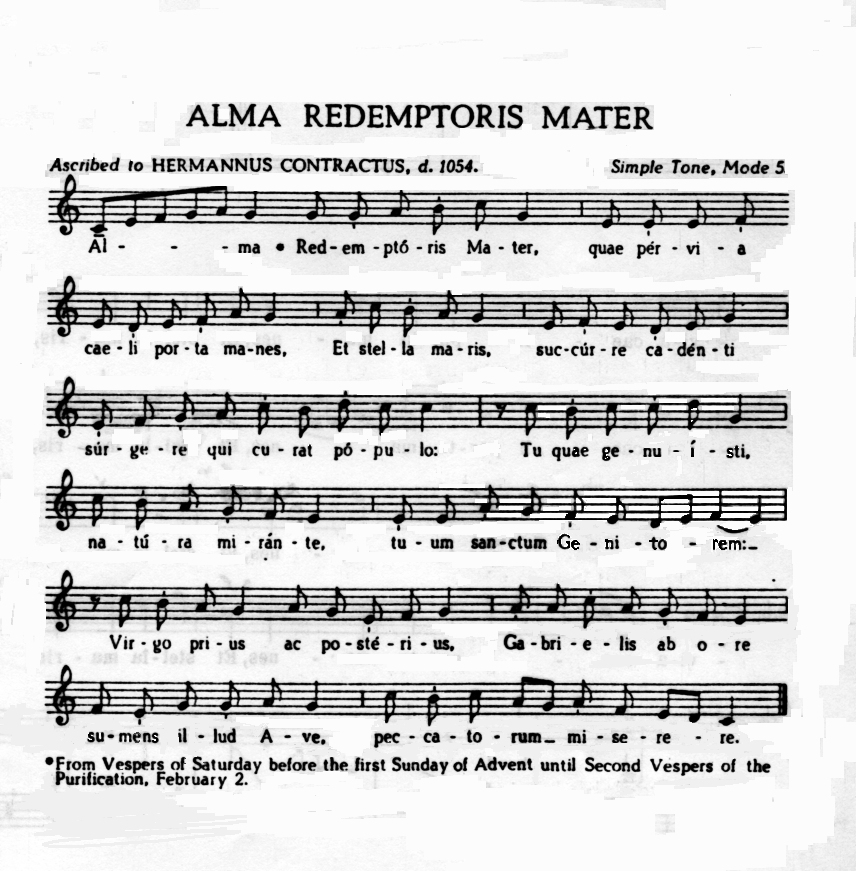 Here's a decent way to learn the traditional chant:
Palestrina's gorgeous polyphonic version:
More about Marian antiphons here
You may find this article from First Things interesting and relevant.
This post is cross-posted from Studeo and revised and updated (particularly with YouTube videos) from they original post in 2006.
Thursday, December 18, 2008
In This Way We Too Become Testimonies of the Light that Christmas Radiates...

Pope Benedict XVI on preparing for Christmas...
Let us prepare for Christmas, therefore, with humility and simplicity, readying ourselves to receive the gift of light, joy and peace that irradiates from this mystery. Let us welcome the nativity of Christ as an event capable of today renewing our existence. May the encounter with the Child Jesus make us people who do not think only of ourselves, but rather open to the expectations and necessities of our brothers. In this way we too become testimonies of the light that Christmas radiates over the humanity of the third millennium. Let us ask most holy Mary, the tabernacle of the incarnate Word, and St. Joseph, silent witness of the events of salvation, to communicate to us the sentiments they had while they awaited the birth of Jesus, so that we can prepare ourselves to celebrate in a holy way the coming Christmas, in the joy of faith and enlivened by the determination of a sincere conversion.Read the Rest Here (from his December 17th audience).
hat-tip Amy Welborn
The photo is of the statue of Our Lady of Bethlehem at Mission San Carlos Borromeo (Carmel Mission) in Carmel, California.
Tuesday, December 04, 2007
Review: The Last Straw
 The Last Straw by Frederick H. Thury, 2006, Charlesbridge Publishing, hardcover
(also - 2004, Zero to Ten, Softcover)
Ages 4-8
To celebrate Christmas in addition to baking Christmas cookies, setting up the manger scene, decorating the tree, and numerous other seasonal activities, we also like to pause in out preparations to cozy up together and read good books that encapsulate the true meaning of Christmas. The Last Straw by Frederick H. Thury is one such book.
Hoshmakaka is a grumpy, old camel, who would rather do anything than carry gold, frankincense, and myrrh to Bethlehem. He is sleeping peacefully one night when he is visited by voices informing him that the wise men have chosen him for this task. He balks at the idea, providing feeble excuses, but when a furious wind blows the sand, he changes his mind.
The next day as the servants of the wise men are placing the precious gifts on his back a group of young, admiring camels comments that he must be very special. His pride puffed up, he brags that he is “as strong as ten horses” and then allows the young camels to accompany him along the journey. This could be his downfall. Will they find out the truth?
Along the way, one after another person or animal begs Hoshmakaka to carry a gift to the newborn king, creating a mountainous pile on his back. Finally, he comes within sight of Bethlehem. Feeling the strain of the weight, he doubts he will make it when a small voice asks him to carry one more gift for the baby.
Can he do it? Will he make it?
The pictures are delightful. My children enjoyed picking out the gifts piling up on his back. It has also become a familiar line in our home to say, “My joints, my gout, my sciatica.” And the ending is superb! All ages will enjoy this wonderful story.
Reviewed by Elizabeth Yank (12/4/2007).
Available from Adoremus Books and Hillside Education.
Sunday, November 25, 2007
Review: Advent Reflections, Come, Lord Jesus!

Advent Reflections, Come, Lord Jesus! by Archbishop Timothy M. Dolan, 2007, Our Sunday Visitor, 64 pages, softcover, Catholic.
In Advent Reflections, Come, Lord Jesus! Archbishop Timothy M. Dolan shares four meditations, one for each week of Advent: “The Threes Comings of Jesus,” “St. John the Baptist,” St. Joseph: A Man Forgotten,” and “Our Blessed Mother Mary.”
With his earthy, conversational tone, Archbishop Dolan’s speaks to our hearts. As he talks about St. John the Baptist, he says, “You see, John’s entire ministry was captured in that one moment when he eyeballs Jesus coming out of the desert and bellows out to the crowd, pointing to Christ, ‘Behold, the Lamb of God, who takes away the sin of the world!’ (John 1:29). That was his job description—to point out Christ. With that, his job was done. He could have retired to Sun City.”
Archbishop Dolan combines teaching, inspiration, personal experience, and scripture in this lively text. To illustrate a point he is making, he weaves in short personal stories or adds scriptural passages that add depth and meaning.
Too often we listen to a sermon or read a spiritual book and later can’t recall what we have heard or read. To help us better remember his essential points, Archbishop Dolan uses catchy phrases. In describing “The Three Comings of Christ,” he says, “Our Lord comes to us in history, mystery, and majesty.”
Advent is a time of waiting and longing for the coming of our Lord. With all the bustle of Christmas preparations, it is easy to lose our focus on what this season is all about. Archbishop Dolan seeks to keep this message of hope alive with words of inspiration, questions for us to reflect on, and a prayer to carry us into the coming week.
Although there is only one meditation per week, instead of daily, there is plenty for us to reflect on during the week.
Not just “pretty” words, Advent Reflections, Come, Lord Jesus! challenges us to put our faith in action. This is an ideal resource for the whole family.
Reviewed by Elizabeth Yank (11/25/2007).
Available from your favorite Catholic book store.
Subscribe to:
Posts (Atom)