Showing posts with label Science. Show all posts

Wednesday, October 14, 2009

Ana's Picture Book of the Week

Galileo's Leaning Tower Experiment by Wendy Macdonald, 2009 Charlesbridge Publishing, 32 pages.

World Geography, World History, science... and some creative fictional characters as well! All in a beautiful information Picture Book.

The story of the legendary Leaning Tower of Pisa experiment by Galileo is brought to life here around the story of a boy, Massimo, who was very clever, and dropped his father's lunch from a bridge everyday in calculating motions... until a passer-by professor named Galileo witnesses it and rethinks the whole Aristotelian notion on the subject!

The pictures are colorful, warm and very pleasant, and some of the angles are taken from delightful perspectives!

A gem. A very nice way to introduce children to Galileo and to some concepts of Physics.

Monday, July 20, 2009

40th Anniversary of the Moon Landing


You can watch and listen to the events in real-time + 40 years at this website starting in about 10 minutes:

We Choose the Moon

The NASA website also has a page commemorating the Apollo mission's 40th anniversary here:

NASA - Apollo


Also check out:

Google Moon

We're also planning on watching NOVA's To the Moon today.

Wednesday, March 25, 2009

Cool Series on Catholic Scientists

(cross-posted from Unity of Truth)

Dr. Thursday is doing an amazing series of short biographies of Catholic scientists. Check out the index to the series here:

GKC's Favourite: Catholic Scientists

Thursday, July 03, 2008

Help firefly research this summer

From: Ecological Society of America

I am a firefly researcher and I have been collaborating with the Boston Museum of Science on a Citizen Science Firefly Survey on-line. We are interested in the distribution of firefly populations and we need your help.

Please follow this link to the website to participate in the survey:
https://www.mos.org/fireflywatch/

Thank you,
Kristian Demary

Thursday, November 29, 2007

Review: The Story of Science: Newton at the Center

The Story of Science: Newton at the Center by Joy Hakim
2005, Smithsonian Books, 256 pages, hardcover

Also see Mary Daly's review of the first volume in this series.

Hakim's The Story of Science is an attractive but frustrating piece. Her comprehensive portrayal of the history of physics is extensively researched and beautifully illustrated, but marred by a steady stream of errors of science and history and an irritating political and philosophical drumbeat about things like population control and the proper separation (only now known to man) between religion and science.

The history of science is ambitious topic, requiring both an insight into science and a knowledge of history. It was perhaps wise to exclude almost completely the life sciences – biology, medicine, anthropology, and paleontology -- as well as the earth sciences of geology and meteorology. No controversy about Darwin here! Nevertheless, having made that decision, it might have been well to rename the book, indicating that it would be primarily "the story of physics", with substantial segments on chemistry and astronomy (which could hardly be left out of the history of physics) and no more than a passing mention of other topics.
It would be still clearer to say that Hakim is here presenting the stories of the physicists, in chronological order, with brief and mostly modern explanations of the insights they were working through. This is enough subject matter to be very challenging, very interesting, and certainly more useful than long explanations of old and erroneous ideas. We see the faces of the physicists, their equipment, and the geography of their homes and travels. Sidebars on the scientific or mathematical principles they were investigating are mostly well done but make it difficult to sort out what was actually known at a particular time, and are so numerous as to distract from the flow of her present-tense narrative.

Hakim's errors of science range from minor failures of clarity and information to real confusions indicating that she does not understand her material. The book cannot be used as a stand-alone science course; it must be checked.

- In a minor misstatement, she reports (p. 51) that Tycho Brahe "guesses that the stars are at least 700 times further than Saturn. He is wrong about that; the nearest star is more than 20,000 times farther…" Well, if his guess was "at least," he was right of course. What is important here is to note what a stretch was required of the 17th century imagination. The difficulty of accepting a sun-centered cosmos was not just traditionalism, but the radical expansion of our imagination regarding knowable space.

- More problematic is her boxed discussion of Tycho's supernova. First, (p 50 blue print in the green box) she says that "[I]n a split second, a massive star runs out of fuel… gravity collapses the core." Well, the collapse is sudden, and it happens after the star runs out of fuel, but the running out of fuel is not particularly abrupt, and it is the cooling after that depletion that brings about sudden collapse. And actually, Tycho's supernova worked a little differently, because it was not a core-collapse supernova. So it gets worse…

- (In the same box, black print,) Hakim says that "a supernova explosion destroys the original star. A nova explosion happens on the surface of a white dwarf…" On page 51, (still in the green box), she offers an image of "what's left of Tycho's 1572 supernova… There's no trace of a stellar core which suggests that the original star was a white dwarf in a binary system rather than a red giant. If a core does survive, it can become a neutron star or a black hole." So does a supernova destroy a star, or can it leave a core? And was this a nova – as suggested by the mention of its being a white dwarf -- or a supernova? An attentive student must run through several sources to find the answers. An ordinary reader may shrug – astronomy is too difficult for me!

- On page 85, there is a discussion of Galilean relativity. This is an unusual term, likely to confuse her readers as it certainly confused Hakim herself. She states that Galileo merely reported the visual difference between the appearance of a vertical path when a ball dropped from a mast and viewed by the moving ship's passengers -- and the curved appearance of the same ball's path as viewed from shore against a stationary background such as quiet clouds – my addition; there should be clouds in the picture – or something clearly stationary. Hakim says that "Albert Einstein, in the twentieth century, will help with the explaining." We don't need Einstein for this one; Newton works. A cloud will do it, and an artist who knows what he is illustrating. Einstein's topic was far more subtle.

- Hakim reports (p. 289) that "Hydrogen molecules (H2 with only two protons and electrons) are small and light. Most other molecules are heavier." Well, if molecules are composed of two or more atoms, all other molecules are heavier; this is her definition in two places. But, without commenting on the discrepancy, she alternates this with a definition which allows for single atoms -- such as those of the noble gases and the metals of coinage -- to be considered molecules. This is very confusing, and one wonders what she herself intended to convey.

- In discussing Avogadro's insight into gases, Hakim reports that: "His idea only makes sense if the particles in a gas are far apart, with space between them (which is the case – even for liquids and solids.)" No, no! This is only about gases. Adding the liquids and solids means Hakim didn't get the picture. Will her readers? (also p. 289)

- Hakim says, "An ellipse is not just any old oval; it has a precise curve." It would be best to say nothing about ovals, which are wider at one end, like an egg, but which do have a "precise" mathematical definition. (While the two foci of an ellipse are points, an oval has a circle at one focus.) Comparing the mathematical and astronomical term "ellipse" with the colloquial (not mathematical) term oval is too bad. (p. 358) Besides, she discussed the drawing of ellipses on pages 129-131. Since this is a history of sorts, it would have made sense to mention in this drawing lesson that the conic section was from Apollonius of Perga in 200 B.C. and the pin drawing was James Clerk Maxwell's idea in 1845.

- Hakim reports that metals "mostly have high melting and boiling points (except for mercury, which is the only metal that is liquid at room temperature) ." Yes, well, mercury has a very low melting point, but gallium melts in your hand, so that's a pretty low melting point too. (p. 296)

As I said, a range of errors of many types.

Her sense of history as a setting for the story of science is worse.

The first two paragraphs in the first chapter takes us right to the heart of the matter – the first one is about population growth leading to deforestation, starting in the Middle Ages. The next is a rather poorly considered piece on St. Joan of Arc, not a personality who needed to be included – rather carelessly -- in a history of science, merely to provide some color for the years before 1453, Hakim's starting date for this volume. As is often the case throughout this work, this loaded "setting" story is simply off-topic.

Continuing the topic of deforestation, we find, on pages 2-3, a full spread with images and text explaining how deforestation began in the Middle Ages, and continues with the destruction of the rainforest. "Big question: Will the forests continue to be threatened by population growth?"
This gratuitous tree politics with its eugenic bias raises all sorts of political and philosophical questions, not to mention that the very progress she lauds really depended on the plow because you can't do science until farming gets easy enough to leave time for other things. Anyway, a book in which the Big question is overpopulation is opposed to the Catholic attitude towards the miracle of human life. Big red flag right there on page 2, and it goes on.

Of course most of the history errors are the usual ones having to do with the stupid old middle ages, the foot-dragging Church, and the wonderful Greek and modern thinkers.

For example, Copernicus (p. 31) is about to make discoveries that "will challenge everyone's ideas about the heavens and the Earth," says Hakim, winding up to his sun-centered universe. But when we get there, we find (p. 38) that Aristarchus has been there. So now are we to suppose that Copernicus was the first guy to read Aristarchus since 200 B.C.? Nor is she correct in asserting that "the Aristotle/Ptolemy model has worked well enough for centuries." It was precisely because it didn't work well enough that Copernicus was asked to correct it. Of course it is only too well known that some people were irritated by the work of Copernicus, but by no means "everyone", for the Church which requested Copernicus' research set about using his work and had the new calendar in 40 years.

In philosophy, Hakim shows the colors of her consultants when she states (p. 19) that "The act of observing the [subatomic] particles changes their behavior." This is part of the thinking of many, but by no means all 20th century physicists, not of Einstein for example. Philosophically, it is called positivism; it is going out of favor, and it has arguably hobbled physics for half a century. In any case, it is not an established scientific fact, and it is opposed to Catholic philosophy, for it leads directly to the question whether anything can be known at all, as she puts it: "Is there really any certainty in science?"

Then, at the end of her book, Hakim raises the question why the western world has been the leader in scientific thought. Her answer, admittedly personal, is that we have the Greek heritage of freedom plus the Renaissance insight of tying mathematics to physics. Perhaps she does not even know that Father Stanley Jaki (20th century physicist and theologian with a specialization in the history of science) has argued for a very different answer – a conviction of order that only came with Christianity. This is not the place to argue with her, but only to say that she hasn't read the basic alternative arguments, (either Jaki or the more accessible Thomas Woods) on this topic and her answer is merely an uninformed and irritating opinion, oblivious of the Catholic contribution, and not seriously related to the actual history of science.

One last complaint would be hilarious if it were not meant seriously. On page 97, Hakim is talking about the end of our sun and wondering where we'll be when it goes: – "maybe in another solar system or another galaxy or another universe."

Hmmm. Another solar system is not such an easy matter.

Another galaxy? Clueless. As ignorant of the meaning of distance as Brahe was about the distance to the stars.

Another universe? Such words seemed to have a meaning when we thought other galaxies were other universes; now they are just noise. It's heaven or nothing, folks.

Reviewed by Mary Daly

Sunday, April 22, 2007

Review: Easy as 1, 2, 3

Easy As 1, 2, 3: A Catholic Overview of Science For the Primary Grades by Nancy Nicholson
2002 (Second Edition), Catholic Heritage Curricula, 44 pages, softcover

This is the second edition of a 1998 volume by CHC with the same title. While it has an all-new layout, much of the content remains the same.

This is a teacher's manual of sorts for those "seeking a primary-level presentation less restrictive than a text", as the author states in the introduction. The author recommends using Childcraft: How and Why Library by World Book's editions predating 1980 and The Everyday Science Sourcebook to go together with this guide, along with library books. (Note: I found very inexpensive used copies of both of these resources available on the internet). The author also cross-references her suggestions here with stories from her volume entitled "Catholic Stories from Science 2", also available from CHC.

The eleven units are divided into two parts each, the first entitled "Find Out" and the second, "Faith". The first one offers suggestions of themes to read about, activities to do and interesting concepts to research about. Also, each unit offers three sets of topics for 1st, 2nd and 3rd grades. I find this helpful especially if you have an emerging first grader and a more advanced third grader, let's say. The third grader will be ready for more intricate topics, while the first grader will be happy to be included, focusing on more basic topics.

For example: on Chapter 3, "God Gave me Five Senses", 1st graders topics are sight, hearing, taste, smell and touch; the 2nd grade topics are sound--waves and vibration--and taste; while 3rd grade students study vision as well as the basic structures of the eye and the ear. Under Find Out several activities are suggested: testing the children's sense of touch by feeling things in a box; testing the sense of smell by smelling different items while blindfolded, and also tasting things while smelling an onion to see how smell affects taste. The activities for studying sound waves and vision are directed towards the student instead of the parent which I think is a good idea. Experiments with sound waves' speed using loud noises on an open field, and an interesting experiment with after-images and low-light vision are suggested, which can be done easily at home. The layout offers generous blank side columns for jotting down book lists and "new discoveries". These side columns also offer the related stories from Catholic Stories from Science 2.

Continuing to use Chapter 3 as an example, under Faith the author offers a brief discussion of how we cannot always rely solely on our senses: that something exist beyond them, and that trust in God is necessary. Msgr. Robert Hugh Benson and St. Thomas Aquinas are both quoted, the latter with the Adoro Te Devote, the traditional Blessed Sacrament hymn that address exactly how our senses can be deceived. A very clever quote!

Easy as 1, 2, 3 can be a very useful curriculum provided this is what you are looking for: a guide to lead you through science topics during the year, perhaps with more than one lower-elementary school child, tying it all with our Catholic faith.

Available from Catholic Heritage Curricula and Adoremus Books.

Reviewed by Ana Braga-Henebry, M. A.

Tuesday, February 27, 2007

The Story of Science: Aristotle Leads the Way - notes on Chapter 29 by Mary Daly

The chapter opens with a quote from Epicurus, Roman philosopher, stating baldly that there is nothing to hinder an infinity of worlds.

Actually, there is.

It's meaninglessness.

With an infinity of physical worlds, the ancient sense of emptiness in this world is as much in the forefront as with a single world of infinite age and cyclic repetition. Meaninglessness is not, of course, a scientific category; it is purely philosophic. But precisely on that score, the question of an infinity of worlds is not a scientific one, since there is no way that even a second universe could be verified, let alone a jillion of them or an infinity.

[The reason that only one universe can be known to science is very simple. If there are two universes, either they share gravity and electricity or they do not. If they do, it's one universe. If they don't, there's no communication, and nothing scientific to say, though there might be something philosophical or judicious, such as: "Get a grip.".]

Lucretius is then quoted for his certainty that there are other worlds like our own. Keep in mind that for men who assumed that the heavens were made of a different matter than earth, our present knowledge of other planets even in the solar system would have seemed to answer as "other meetings of the atom stuff resembling this of ours." Anyway, again, this is not a scientific idea; it is a philosophical one. Therefore its presence in a book on the history of science is evidence of a philosophical position on the part of the author, no more.

Asimov, a good physicist, a pagan, and a thoroughly amateur philosopher, gives the third philosophical salvo in this chapter. He opines that it is "unlikely" that earth is the only world with life. What, exactly, does "unlikely" mean in this context?

Let me explain something.

Every radio communication we have is broadcast, as light is, in every direction. This earth positively glows with radio broadcast. If there is intelligent life out there, they have seen us. Where are they? More to the point, where are their radios? Radio is so intimate a part of the natural world that they must have discovered it, if they exist. From that perspective, we can feel fairly safe in the conclusion that nobody of a similar advancement lives anywhere nearby. This effectively closes the question of many other intelligent worlds. There might be a few, but there are certainly not "many".

For a scientist to talk about the lack of other civilizations as "unlikely" (that is, to speak of non-human civilizations as "likely") in the circumstance where the only evidence we have points to solitude, is simply silly and totally unscientific. It's not a history of science, but an argument for science fiction.

Hakim continues the chapter with a fictional account of another intelligent race, the Thuleans, who discover us and also figure out how to travel through "wormholes" so as to circumvent the limiting factor of the speed of light. They are from another galaxy, and traveling at the mere speed of light would be too slow. It is true that the limitations of the speed of light do severely limit space travel and make the issue of other intelligent beings pretty irrelevant.
The wormhole idea is pure science fiction, absolutely so. It is related to the idea of strings, which is a serious idea, but even strings would not allow the type of travel Hakim suggests, any more than the basic emptiness of most of the space in an atom allows us to go through doors.
Hakim continues. The Thulean scientists become particularly interested in a place called "earth" by its most evolved life form, and they send further expeditions, beginning in the Jurassic period. OK, stop. No humans in the Jurassic. Zip. They didn't see us and then come to visit our dinosaurs.

Anyway, they keep coming and watch the evolution of mammals, including ourselves (Oh! Oops! I guess there weren't any humans after all on that first visit when the locals called it "earth." Maybe she meant that dinosaurs talk...?) They notice that we are fairly intelligent but with a disturbing tendency to kill each other.

Really? The Thuleans didn't notice this about the dinosaurs? Or about the gorillas? And there is no murder among them? No pride, envy, anger, lust? No revenge? No sloth? So all this is new? An unfallen race! Has Hakim just stumbled into a race with Original Innocence?

Or, uh, has Hakim just never thought seriously about the topic? Not that war is intelligent, but virtue is work, and smart people who are lazy use war to get what they want. This is not only a human characteristic. It was also angelic. Can the Thuleans not know of it?

The Thulean report (p. 263) refers to two types of creatures, called men and women. Surely nobody, even from the distant outside would fail to observe that these are the male and female forms of a single species!

The Thulean report finds Athens of Greece more astonishing than the Italy of Fibonacci, Giotto, Dante, Plutarch, DaVinci, and Michelangelo, or the Europe that includes all of these plus Aquinas, Buridan, the Benedictine farmers, the cathedral builders of France, and the millwrights of Holland?

They are delighted by Greece, by Athens particularly, and somewhat by Rome, although that Republic is darkened by slavery. Evidently they do not notice that the Greeks practice slavery or that it is exclusively the Christians who get rid of it again and again, all across Europe.

Although the Thuleans have seen and report on the Sumerian, the Ming, the Egyptian, the Mayan, the Islamic and the American civilizations, they have not seen Christendom, only unimpressive "Europe". This is a strange collection of civilizations! The Sumerians are ancient, pre 2500 B.C., while Ming China is 14th to 17th century, the Egyptians are ancient again, the Mayans sprawl across a vast time period from ancient into the second millennium A.D.. The wonderful Islamic civilization is not dunned for their slaves, their warfare, or their attitude towards women; and who, pre-1500 but not Mayan, does Hakim mean by the "American" civilization? This easy read is just not a careful or meaningful piece of work.

Let's talk about the 15th century when Hakim says that the Thuleans noticed that "science seems just about dead." The negative view of 1500 is Protestant, through and through. Is this a purely unconscious bias? Maybe so, but it is so politically irritating to Catholics I must invite a brief look at the 15th century:

This is the height of Portuguese exploration, upon which the work of Columbus is based at the turn of the century. It is the century of the printing press, which instantly changed the movement of information. It is the century of Leonardo DaVinci.

Here is a list of the universities founded in the 15th century:

1409 Leipzig University founded
1411 Founding of St. Andrews' University in Edinburgh
1425 founding of the University of Louvain
1431 Universities of Caen and Poitiers founded
1437 All Saints College, Oxford founded
1451 University of Glasgow founded
1479 Copenhagen University founded
1500 first commercial colleges founded in Venice

In 1517, Luther was to begin the split of Christendom by announcing a debate in the manner normal to his times, namely a poster on the door of the Church. How could science and debate seem just about dead at this date?

What about the concept of inertia, dating from 1351?

What about Nicholas of Cusa, Italian, 1400-1454, who believed that the earth was a star like other stars, that it was not the center of the universe, that celestial bodies are not strictly spherical, nor their orbits circular. He was a cardinal and canon lawyer.

What about Thomas of Linacre, English, founder of the Royal College of Physicians of London, and translator of Galen.

What about Nicolaus Copernicus, Polish, born in 1473, who was hard at work in 1500; in 1514 he would be asked by the Church, to chart the motions of the stars. He was careful about whom he might offend, but he was not afraid to think, and many were anxious to hear his thoughts.

Moving on from the Thulean description of Earth 1500, Hakim returns to her pet issue of other worlds, and discusses what has been written by 20th century physicists on the matter. She makes it clear that anyone who doubts that there is other intelligent life is like those dark-minded Europeans of pre-1500. Davies and Dyson are quoted, and on the strength of their opinion, we are assured that we will feel less lonely if we accept these hidden friends into our consciousness.

Meantime, on genuinely scientific grounds, as opposed to pathetically unformed philosophical opinions, Ward and Brownlee have shown that earth is an incredibly rare phenomenon, far more rare than Asimov or Carl Sagan or Davies or Dyson would have us believe. Their conclusion is not based on theology, but on hard science. Hakim mentions their book, Rare Earth late in the chapter, but after a quick summary of their conclusions, asks the ignorant reader, "Do you agree?" As if this were science, to take a position on something about which you have zero information! As if it were scientific to base our status in the universe on our opinions – our ignorant opinions -- about other intelligent life!

There may or may not be other intelligent life, in this universe or in some other, but our role in this one and our interior sense of human value are not based on the discovery or expectation of such beings; nor can a man's scientific spirit justly be judged by his position on such a blind issue.
One cannot but ask: whose bias wants "other worlds"?
  • 1) The Christians don't care; we are willing to love any persons we meet, but we are at home here whether or not anyone shares the wide universe. In The Universe in My Hands, I have discussed the fact that the universe has to be this size for even one civilization, so it's not like it's too big for us.
  • 2) The Moslems don't care as far as I know.
  • 3) Evangelicals are likely to be either offended or bored by the idea if they consider it at all.
  • 4) Jewish faith does not address it.
  • 5) The Hindus cannot care about this any more than about anything else.
  • 6) Confucians only want ethics from any and all worlds; they are not, as a faith community, cosmologists.
  • 7) Buddhism is not cosmologically minded. Zen Buddhists only want to meditate.
  • 8) The only group that really wants other worlds, really hungers for them, is the new age type, which largely runs the public schools. If you write for public schools, it makes sense to write for them.

This is perhaps a disproportionate attention to one chapter in what is a generally engaging and informative book, but it is also a politically biased book, and since there is a general feeling that science is the one field free of bias, it is necessary to say that the book is deeply biased – in a politically correct manner. Caveat emptor.

Review: The Story of Science: Aristotle Leads the Way by Joy Hakim

The Story of Science: Aristotle Leads the Way by Joy Hakim
2004, Smithsonian Books, 282 pages, hardcover

Joy Hakim is a talented story-teller, as readers of her American history series can attest. Her presentation of the history of science, ably illustrated with colored images of scientists and their apparatus and their books will engage the student and readily acquaint him with all that he is likely to be expected to know (in the politically correct sense) about the history of science.

It is the "politically correct" aspect that warrants some caution.

Joy Hakim is not herself either a scientist or a historian, and several annoying but commonplace and politically correct assumptions about science are reinforced by her work, to wit:

  • That religion and science are in conflict.
  • That the history of science basically begins with the Greeks, pauses for the Dark Middle Ages, and resumes for the Reformation/ Enlightenment.
  • That science involves a particular type of thought, in the long run the best kind of thought and the only one that is really dependable and serious.
  • That science fiction is a source of suggestive ideas about the nature of man, and since it has a veneer of science, these suggestions will be welcomed by all men of good intelligence.
Here are some of the details of her thought about religion being in conflict with science.

The presentation of science as a constant conflict with religion begins at the beginning of the text. On p. 48, for example we learn that the religious and political leaders were "aghast" with the ideas of Anaxagoras (500 – 428 B.C.), who said that the Moon had mountains and shone by the reflected light of the sun. It is a curious fact that in writing this first volume, titled: Aristotle Leads the Way, Hakim does not note that Aristotle himself, several generations after Anaxagoras, in 350 B.C., rejected these ideas about the Moon. This is important because it shows that the academics were in disagreement among themselves, not busily making "Scientific Progress" except as inhibited by hysterical religious leaders.

The battle continues on p. 91 (in a sidebar) where Hakim laments that unfortunately we can't read the works of Democritus because they were destroyed by religious zealots. Whom does she mean? Plato wanted to burn his writings, but did not have the power to do so; worth mentioning to recognize that there were academic conflicts about his ideas. Some claim that the books were burned in 391 by Christian monks; this refers to some sort of political chaos in which the Library at Alexandria was damaged, but it has nothing to do with singling out Democritus. Caliph Omar ordered that all the books in the Alexandrian Library – excepting the works of Aristotle -- be burned to heat their baths in 642. Again, Democritus was not singled out. And by the way, now we know why Aristotle so dominates our knowledge of Greek thought. Thanks, Omar.
Finally, it is worth mentioning that the books in this library contained a mixture of sorcery and science; this was the source of the discord. I would probably burn a good number of the books myself if they were found in my family library. Of course I would want to sort them first, and 700,000 books is more than I can sort…

So much for religious zealots.

Skipping ahead, chapter 22 is entitled, "A Saint who was No Scientist" referring to St. Augustine. Actually, for his time Augustine was moderately good at science, considering that it was not his primary vocation. He specifically urged that the Christians not say things about science that pagans would certainly dismiss as stupid for this might cause them to dismiss the gospel, -- good advice today. And he made a mammoth effort to bring the understanding of Genesis 1 up to date – his date.

To her credit, Hakim mentions that some scholars dispute the idea that the dark ages were so very dark, and she urges her readers to do their research. This is a little unfair. The idea of writing a textbook is that you are laying out the essentials and the readers may do further research. She doesn't even list the people they might research in order to consider the merits of Medieval science:

- St. Isidore of Seville in the 7th century, St. Bede in the 8th century, and Rabanus Maurus in the 9th century all worked on encyclopedias, humble efforts to set forth what was known in an orderly manner. Coming out of the piracy that marked the fall of Rome, these efforts were humble but important for the resumption of culture.

- John Scotus Eriugena (12th century) set forth a layout of the heavens with Mercury, Venus, Earth, Mars and Jupiter orbiting the Sun, though not Saturn.

To be sure, Hakim's book actually has marginal notes and side bars with other resources that might be pursued, but since these are not well-integrated into the text, a student might not notice them as a resource for further research.

Reviewed by Mary Daly (2-28-07)

    Wednesday, February 14, 2007

    Review: An Egg is Quiet by Dianna Aston

    An Egg is Quiet by Dianna Aston; illustrated by Sylvia Long
    2006, Chronicle Books, 30 pages, hardcover

    Truly a "living book" in the fullest sense, An Egg is Quiet is a visual delight, full of soft, gentle colors and beautiful pages that manages to incorporate a great deal of scientific information without looking like a science book at all. This is a field guide to eggs for the youngest scientists, perhaps through the early elementary grades, that also feels like a story book with a surprise, but not wholly unexpected, ending. It will be nearly impossible to resist drawing and sketching and painting from the numerous illustrations in the text; a young or young-at-heart nature artist will be busy for days and days. Featuring eggs from birds, reptiles, and insects, the primary text on each page appears in a large, calligraphic cursive font so that Mother may not need her reading glasses. Supplementary notes about specific illustrations are included in an easier-to-read, smaller printed font. An Egg is Quiet is a perfect addition to your Lenten reading basket or any springtime nature study. Be sure to bring home a new sketch pad and color pencils when you bring home this book!

    Non-fiction, early elementary

    Reviewed by Susan Kalis (1-27-07)
    Available from your local library or bookstore

    Note Bene: This was just announced as the winner of the Cybil Award for Non-Fiction Picture Books

    Tuesday, December 26, 2006

    Review: The Seashell on the Mountaintop by Alan Cutler

    2003, Plume Publishing, 240 pages

    The Seashell on the Mountaintop
    is a very welcome biography of St. Neils Stenson, also known as Nicholas Steno and about 16 other variations. The good news is that, after years of neglect, this convert, this holy man, and this founder of the science of geology is being pulled from the edge of oblivion to be remembered for his true greatness. The title of the book refers to the presence of fossil shells in the mountain soils of Italy and , among other places, and the long effort to interpret such a curiosity. As a Dane, Neils had not grown up in the presence of fossils, but he went to Italy as an adult and joined the academy that had been Galileo's fellowship a generation earlier. Here he took an interest in everything around, including the hills of Tuscany and their shells.

    The geology part is interesting because Steno's ideas were so far ahead of others' that those who were interested in figuring out the fossil puzzle read them for a hundred years before they were able to take the next step in building the science. During his own lifetime, Neils was famous for he was a seminal thinker on several topics, but by the time the geologists were able to build on his work, his extraordinary personality was almost forgotten although, even today, the principles expressing our basic understanding of sedimentation are still called Steno's laws.

    Cutler's gives a striking account of the competing ideas about fossils in Stenson's days – late 17th century. Did shell forms naturally grow in the soil? And if so, did they grow with breakages and wormholes and all, just as if they'd been on the shore? Were they dropped by Noah's Flood? If so, how had they come so far inland; many thought that Noah's finding a live tree branch after the flood meant it could not have brought salt water all the way inland everywhere. Cutler presents all this material thoughtfully and in a manner respectful of the mental challenges of another age, so easy to underestimate.

    Not only the shells interested Neils, but also the faith of Italy, and though welcomed by the Florentine academy as a Lutheran, he became a Catholic in time, then a priest, and finally a very holy bishop of a vast tract of Lutheran Europe, for whose salvation he relinquished his scientific investigations and then sacrificed his health.

    This is a good introduction to the 17th century, to geology, and to a saint with a wonderful, Renaissance mind.

    Reviewed by Mary Daly (12-26-06)
    Order through your local bookstore

    Saturday, December 16, 2006

    Review: Chemistry 001

    Chemistry 001: Introducing the Periodic Kingdom to its Heirs
    by Mary Daly
    illustrated by Ana Braga-Henebry
    2006, Ye Hedge School, 66 pages, softcover

    Written in Mary Daly's characteristic style, this is a pleasant introduction into a subject that some might otherwise view with trepidation. "Chemistry 001" introduces the student to the periodic table, here called the "Periodic Kingdom," and the elements of which it is composed.

    The Periodic Table (or Kingdom) is presented in its major divisions, here called "latitudes" (rows or periods) and "longitudes" (columns or groups). The elements are introduced by latitudes, beginning with the atomic structure of the elements in that latitude. Diagrams of the appropriate
    electron shells are given in these introductory sections.

    Each element has its atomic number and symbol listed, followed by a brief description, often with amusing or entertaining anecdotes. A colorful illustration ties in with the description. While the illustrations are not "scientific," they did serve to remind my student of what he had just read. He enjoyed finding the symbols hidden in each picture.

    A few additional basic concepts are included, such as molecules, minerals, isotopes, and radioactivity. One particularly helpful feature was that the text on several occasions points out similar properties in materials that are near each other in the Periodic Table. This is a good first step toward understanding that electronic structure affects material properties.

    The family purchasing this book is permitted to copy the pictures in order to construct its own Periodic Kingdom chart. It is sold with a laminated, smaller-scale version. This can be written on with wet-erase
    markers.

    Suggestions for an even better book:

    • Address the difference between molecules and ionic compounds. (For example table salt, NaCl is an ionic compound. Technically, it is not a molecule as it is not bonded in the right sort of way for that.) This discussion should make the concept of minerals easier to understand.

    • Add pronunciation info for each element.

    • Give a bit more information on how to use the book.

    I did find some minor errors, but Mary has already promised to fix them for the next edition (soon!) so I will not list them here.

    My son and I both enjoyed reading this book so much that we each sat down and read it straight through. He will be doing chemistry again in the spring, so we will revisit this material then and perhaps have some
    updates.

    Thursday, November 16, 2006

    The Art of Construction by Mario Salvadori

    For anyone using (or interested in using) this fascinating book - subtitled "Projects and Principles for Beginning Engineers and Architects", I just happened upon free supplemental materials on the Salvadori website. Looks interesting!

    Monday, September 18, 2006

    Tree Study

    Fall is a great time for nature walks and for learning about trees...

    Lapaz Farm has a very interesting post on the American Chestnut Tree with lots of links about general tree and leaf studies as well.

    Measure the height of a tree using its shadow.


    One of my personal favorite children's books is Why Do Leaves Change Color? by Betsy Maestro. Interesting content and great illustrations!


    Dead Log Alive!
    by Jo Kittinger describes the mini-ecosystem that can be present in a fallen tree. We especially enjoyed learning about mosses, lichens and fungi in this book. My son wrote about it this spring (with some interesting pictures!)


    We've seen lots and lots of interesting fungi, mosses and lichens on trees or stumps on our nature walks lately. Though we've pretty much learned to distinguish between these three, we're not very good at identifying particular types yet. Here are some fun and/or interesting sites on fungi (If I understand it right, lichens are really a union of algae and fungi - those Lyrical Life Science CDs are starting to have an impact!)...

    Fungi
    Lichen
    Giant Puffballs (We really enjoyed the humor here, but aren't brave enough to try eating them - besides which we haven't seen them on our own property before)
    Identifying Tree Fungi

    Also see:

    MacBeth's Book and Activity List for the Fall
    Elizabeth's Fall Reading Lists for All Ages

    Friday, September 08, 2006

    The New Geocentrism

    There's a new post with a series of comments on the relationship of faith and science over on Unity of Truth that's worth taking a look at. You can read it here.

    Wednesday, May 10, 2006

    Eagle Cam

    Irresistible. Two fuzzy, gray eaglets, and two attentive bald eagle parents. We try to check in a couple times a day, and so far have seen a couple of feedings, some stretching and squawking, and of course some napping, too.

    The video quality is excellent. The nest seems so close, sometimes I'm tempted to say, "Shh, you'll scare them away!"

    Thursday, March 23, 2006

    Unity of Truth

    Unity of Truth, our science and math blog for Catholic homeschoolers, is really getting off the ground. Please drop by and read some interesting articles, leave a comment and check out the fun links!

    Monday, March 06, 2006

    Caves and Caverns by Gail Gibbons


    1993, Voyager Books, 32 pages, softcover
    ISBN: 0152013652

    This is a terrific children's picture books, with lots of details about different parts and features of caves, how caves form and plants and creatures that can live inside of caves. Gail Gibbons has a nice balance of real information that is presented in an easy-to-understand format.

    Here's a little sample of the style and content:

    "Next, the cavers carefully enter the variable temperature zone. The temperature doesn't change as much here as it does in the twilight zone. Mushrooms, molds, and other fungi grow here. It is dark!"

    Amazing Caves

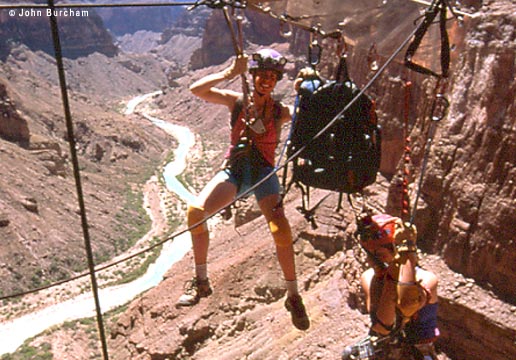
    This weekend we rented Journey into Amazing Caves (an IMAX film). It's a beautifully filmed documentary that traces a group of scientists' explorations into caves in the Grand Canyon, ice caves in Greenland and underwater caves on Mexico's Yucatan Peninsula. The scientists are searching for "extremophiles" - bacteria and other small creatures that survive extreme conditions and may be useful for medicines.

    Just the natural beauty of these remote places is absolutely breathtaking. But watching the "making of" gives you an even greater appreciation as you realize the challenges and dangers of "extreme photography". Wow.

    My children saw this before I had a chance to. I heard them from the other room going ... Woah... Woooah.... Wooooooah... as the team kayaked down a beautiful river.

    The movie references the website of one of the team members who also works as a teaching assistant and put this website together for her grade school class...Nancy's Expedition Diary (I especially liked the Q & A in the "Ask Nancy" part.)

    We love these kinds of documentaries that "work" for a wide age range and help spark an interest in science while providing some real substance. I have to admit that it was quite delightful the next day to see my 8 year old daughter out in our cold, snowy backyard digging into our sandbox and pretending she was a scientist "out exploring."